多视图与结构
这一页检查“各张图是否仍是同一艘船”。主轮廓、港口、舰桥和推进器的位置必须能互相对应,表面的机械细节才有继续深化的基础。
状态:概念身份关系已评阅,精确尺度与空间尚未验证。 这些图由生成式图像工具制作并经过人工评图和返修,不是同一三维模型导出的严格正投影。
外形六视图
跳转到“外形六视图”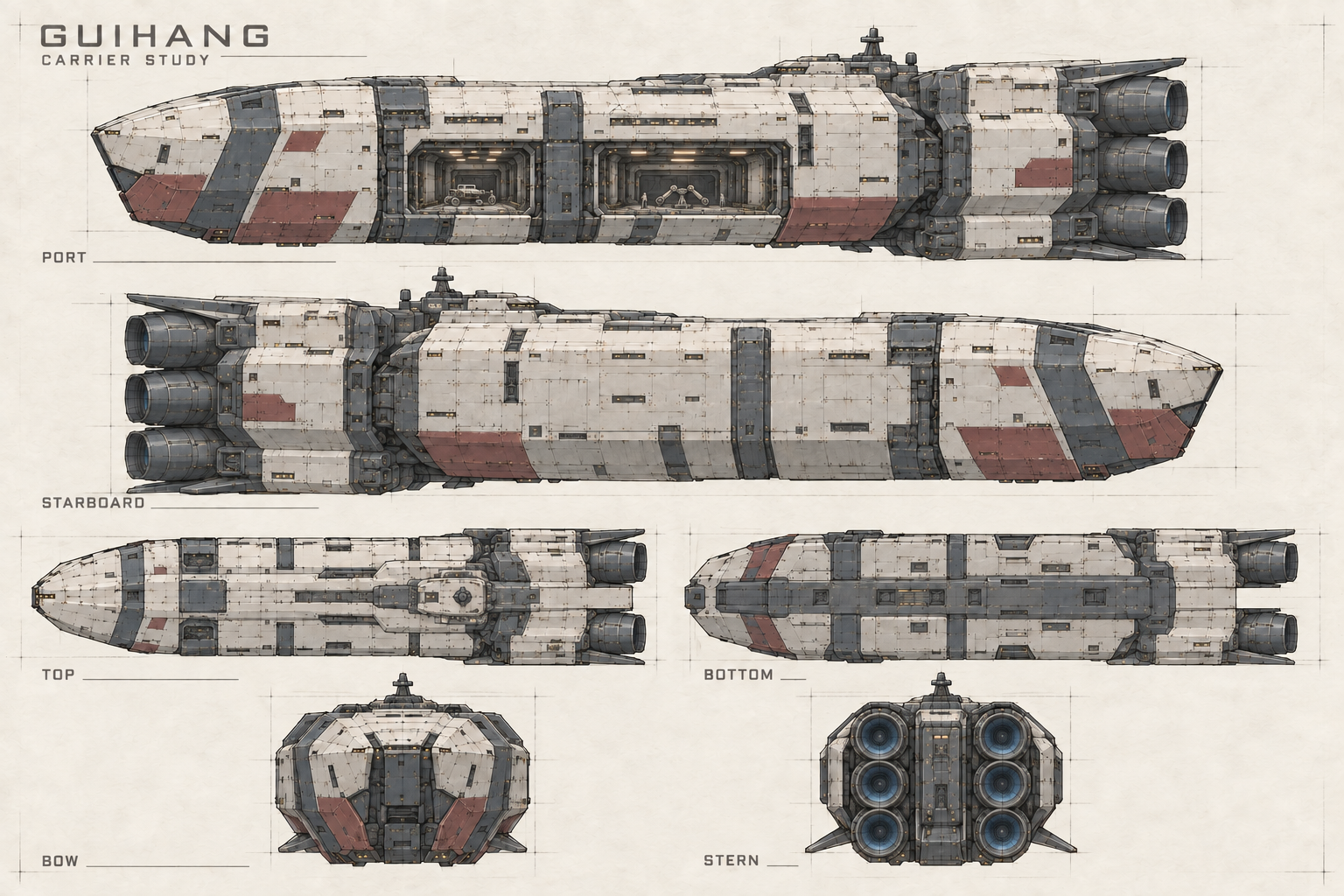
完整生成提示词 2 轮记录 · 原文
AI 图像创作记录 · 保留实际输入原文与修订顺序。
参考图:归航号母版:形体与双港口
参考图用于建立新图的设计关系;其自身的生成与修订记录可从对应图片查看。
Use case: stylized-concept. Create an original HAND-DRAWN industrial mecha concept-development sheet on ivory drafting paper, 1536x1024 landscape. Match input image 1, the GUIHANG mother ship master, as the authoritative exterior visual identity. Warm-white armor, slate blue-gray structure, graphite recesses, sparse brick-red identification, amber work lights. Crisp pencil/ink contour, light construction lines, controlled marker shadows. No photoreal CGI, no fantasy monument, no generic new ship or copied franchise, no fake dimension numbers, no unreadable handwritten paragraphs. These are concept views, not validated engineering projections. Preserve low bridge aft of center, short faceted bow, thick enclosed body, TWO port-side midship mouths separated by one thick pier (forward LAUNCH, aft RECOVERY), six aft engine apertures total in two columns of three, only short fins. Small figures in the reference are schematic, not exact scale evidence.
Asset: coherent six-view concept sheet of this SAME ship, not six alternatives. Layout top two rows each with two long horizontal ship views; bottom row with two end views and generous blank margins. Labels only PORT, STARBOARD, TOP, BOTTOM, BOW, STERN.
PORT: bow left, stern right, BOTH rectangular side service mouths visibly open at the midship waist, bridge in same aft position and three visible near-bank nozzles.
STARBOARD: mirror longitudinal orientation with bow right, stern left; opposite side is plated service access with CLOSED rectangular maintenance panels, no invented open garden or symmetric active hangar.
TOP: bow left and stern right, one central longitudinal spine, paired shoulder masses, compact low bridge, near-side hangar recess corresponding to PORT. BOTTOM: bow left and stern right, reinforced keel and maintenance hatches; no bridge and no duplicated dorsal details.
BOW: short faceted nose facing directly toward viewer, broad shoulder silhouette behind it and tiny centered bridge silhouette above; NO engine holes at the nose.
STERN: directly behind, exactly SIX main nozzles as two vertical columns of THREE circles; structure between columns, tiny bridge above. Do not turn them into four or eight.
All views in restrained mostly orthographic drawing language, no extreme perspective, line weight separates primary silhouette from panel detail. Keep the same bow slope, hull beam, bridge location, port longitudinal position and engine count across ALL views. Fill the page elegantly without overlap. Do not add decorative inset shapes or extra views.
参考图:同舰六视图研究 · 返修前初版
第一张参考图为待修订初稿;其他参考图按原调用顺序提供外形依据。
Use case: precise-object-edit. Image 1 is the edit target, an existing six-view GUIHANG hand-drawn concept sheet. Correct ONE cross-view error only. Keep PORT, STARBOARD, BOW and STERN views, all labels, colors, bow, bridge, openings, page layout and linework unchanged. The STERN correctly defines SIX main nozzles as TWO horizontal banks, each with THREE vertically stacked nozzles. In the TOP and BOTTOM views ONLY, the aft engine modules currently incorrectly read as THREE side-by-side nozzles. Redraw just their aft engine region so each plan projection shows exactly TWO parallel left/right engine housings and TWO visible topmost (for TOP) or bottommost (for BOTTOM) nozzle mouths. The other two nozzles in each vertical stack are hidden directly underneath/above in projection. Do not draw a third central main nozzle. Keep the overall engine-bank width and all upstream hull geometry consistent with the correct STERN view. These two corrected end regions must belong to the same six-nozzle machine. Preserve ivory paper and pencil/marker style. No new text, dimensions, variants or other edits.
完整保留该手稿首次绘制到此版本的提示词原文。历史指令可能包含后来修改或图面尚未达成的要求,不代替概念评审。
这张图的永久记录 ↗左舷双港与右舷连续外壳形成明确区别;艉部为两列、每列三层的六喷口组合。
| 观察位置 | 应保持的身份 |
|---|---|
| 左舷 | 前出击、后回收的相邻双港,中间有结构隔离梁 |
| 右舷 | 连续的载荷外壳,不自动镜像出另一组双港 |
| 顶部与底部 | 主舰身长轴、前肩与后动力段对应,尾部呈两列推进器的可见投影 |
| 舰艏 | 短而厚实的折面轮廓,主色块连续 |
| 舰艉 | 六喷口按两列三层布置,中部保留结构与设备空间 |
初稿曾在俯视和底视画出三列推进器,与艉视冲突。当前页已改为两列;这是部件数量关系的修正,不代表已经完成精确投影验算。
壳板拆解与功能剖面
跳转到“壳板拆解与功能剖面”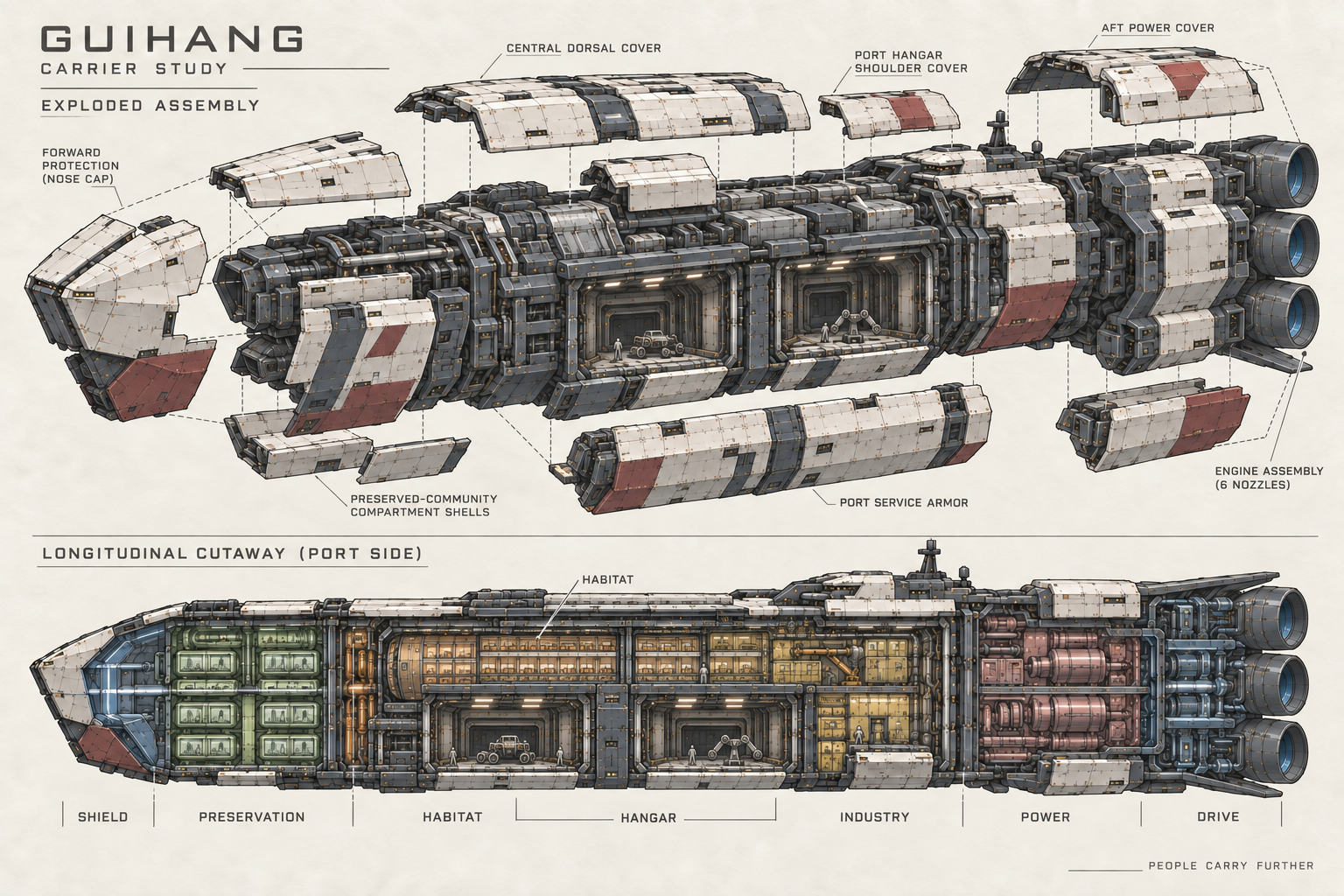
完整生成提示词 2 轮记录 · 原文
AI 图像创作记录 · 保留实际输入原文与修订顺序。
参考图:归航号母版:形体与双港口
参考图用于建立新图的设计关系;其自身的生成与修订记录可从对应图片查看。
Use case: stylized-concept. Create an original HAND-DRAWN industrial mecha concept-development sheet on ivory drafting paper, 1536x1024 landscape. Match input image 1, the GUIHANG mother ship master, as the authoritative exterior visual identity. Warm-white armor, slate blue-gray structure, graphite recesses, sparse brick-red identification, amber work lights. Crisp pencil/ink contour, light construction lines, controlled marker shadows. No photoreal CGI, no fantasy monument, no generic new ship or copied franchise, no fake dimension numbers, no unreadable handwritten paragraphs. These are concept views, not validated engineering projections. Preserve low bridge aft of center, short faceted bow, thick enclosed body, TWO port-side midship mouths separated by one thick pier (forward LAUNCH, aft RECOVERY), six aft engine apertures total in two columns of three, only short fins. Small figures in the reference are schematic, not exact scale evidence.
Asset: clear hull decomposition and internal zoning CONCEPT study for the SAME mother ship.
Upper 60 percent: three-quarter EXPLODED ASSEMBLY drawing of the vessel with its coherent graphite structural backbone continuous. Lift only the major warm-white external armor sections slightly away with dotted guide lines: forward protection/nose cap, preserved-community compartment shells, central dorsal cover, port hangar shoulder cover, aft power cover. Keep both launch/recovery mouths together as a single side assembly. Aft complete engine assembly remains SIX nozzles, two columns of three. Explosion is modest and readable, not a cloud of random parts. Inner functional modules are large architectural volumes, not fully engineered reactors.
Lower 40 percent: same ship in PORT-side longitudinal CUTAWAY, bow left stern right. Clearly separate seven zones in this order and with tiny English labels only: SHIELD at bow, PRESERVATION with isolated sleeping/seed compartments forward, HABITAT inside protected midbody, HANGAR on port side of that region, INDUSTRY aft of habitats, POWER well aft, DRIVE at stern.
HABITAT is an ENCLOSED rotating-drum candidate INSIDE the hull, longitudinal axis, located inward and toward starboard from the port hangar. Show its curved residential decks as an internal module, not an enormous ring sticking out of the exterior or a floating garden. Central service spine is nonrotating. Hangar side module occupies a DISTINCT volume, not drawn through the residential drum. Show a simple separation between life/preservation systems and aft power volume. Front preserved-community blocks have redundancy, not one fragile glowing crystal.
Keep the open twin side bays in the same place as the exterior and the bridge small. Use lightly differentiated muted tints for zones and solid simple structural interfaces. No energy magic, no giant fuel flames, no arbitrary rooms whose scale pretends to be validated. Show how the parts relate; no numerical measurements.
参考图:总体拆解与舱段剖面 · 返修前初版 · 归航号母版:形体与双港口
第一张参考图为待修订初稿;其他参考图按原调用顺序提供外形依据。
Use case: precise-object-edit. Image 1 is the exploded/cutaway target. Image 2 is the authoritative exterior master of the SAME GUIHANG ship. Keep the upper exploded main ship and the overall page, design language, coloring and zones. Correct these exact inconsistencies:
1. LOWER longitudinal cutaway currently shows THREE open hangar rooms. Rebuild that LOCAL midship region to show exactly TWO port-side working openings and ONE thick pier in between, at the same longitudinal positions as image 2. Do NOT merely close the last opening: the current two forward rooms are wrongly packed too far forward. The FORWARD launch opening must span roughly the 28–41 percent section of ship length and the AFT recovery opening roughly 44–64 percent, visually aligned to the reference; percentages are instructions, NOT numbers to draw. Reorganize internal equipment to fit those two bays. Do not put a new third bay under INDUSTRY.
2. The protected rotating-habitat candidate is behind/inboard of those two bays, and upper occupied decks may be visible above them, but the HANGAR label must bracket BOTH existing side bays and HABITAT should use a leader to the inner/upper habitation volume. Keep SHIELD, PRESERVATION, INDUSTRY, POWER, DRIVE labels with their actual regions. Don't add exterior rings.
3. In UPPER exploded view, the text ENGINE ASSEMBLY (6 NOZZLES) currently points to an ordinary detached armor panel. Move its leader clearly to the assembled aft nozzle cluster; the detached plate is just armor, not a propulsion unit. Keep six nozzle total and all key exterior identity.
4. Do not present the detached flat side cladding as though it itself contains working doors; caption it PORT SERVICE ARMOR. The underlying paired bay structure stays connected to the spine.
Preserve clear hand-drawn ink and restrained marker on ivory paper, exact original ship identity, no new styles or dimension claims. Fix the diagram, not merely its prose.
完整保留该手稿首次绘制到此版本的提示词原文。历史指令可能包含后来修改或图面尚未达成的要求,不代替概念评审。
这张图的永久记录 ↗拆解图说明外护壳与内部结构的层次。下方剖面应理解为“上层居住、下层双港”;底部居住标签与机库括号仍有轻度排版歧义,以此说明为准。
从舰艏向舰艉,当前功能关系依次为前向防护、社区保全、中段居住与港口、工业、动力、推进。它们是供美术与空间设计讨论的候选分区,不是已完成容量计算的工程布局。
保全区应体现分区隔离和长期照管;港区需要容纳真实的进出、固定、卸料和维修流程。后段动力与推进在形体上集中,避免把所有复杂设备平均铺满船身。
拆解图的虚线用于回指部件所属区域。外壳可以拆开画,并不意味着已经证明工具能进入、部件能够运出,或结构能按这个顺序安全维护。
本轮修正与下一步
跳转到“本轮修正与下一步”剖面初稿多出第三个机库口,推进总成标签也误指向游离壳板。当前版本已恢复前后双港,并将引线接回艉部推进总成;双港在中段的位置可与主视和侧视对应。
下一步需要一张统一标尺关系页,把全舰、港区外凹槽、内部通行口、机体和人员放在同一套尺度里。旋转居住段的支承、交通与压力接口,还要同固定港区一起推敲。当前六视图可指导后续概念手稿,尚不能直接作为建模尺寸依据。