双港、机库与门机
归航号的左舷设置相邻而独立的出击港与回收港。它们既是玩家离开与返回母舰的入口,也是探索、战斗和采集机体共同使用的维护设施。
状态:流程与部件意图可读,门片真侧剖及统一尺度仍待解决。 本页是概念设计,不表示港口动画、碰撞或机体通行已经在游戏中实现。
从舰内看向宇宙
跳转到“从舰内看向宇宙”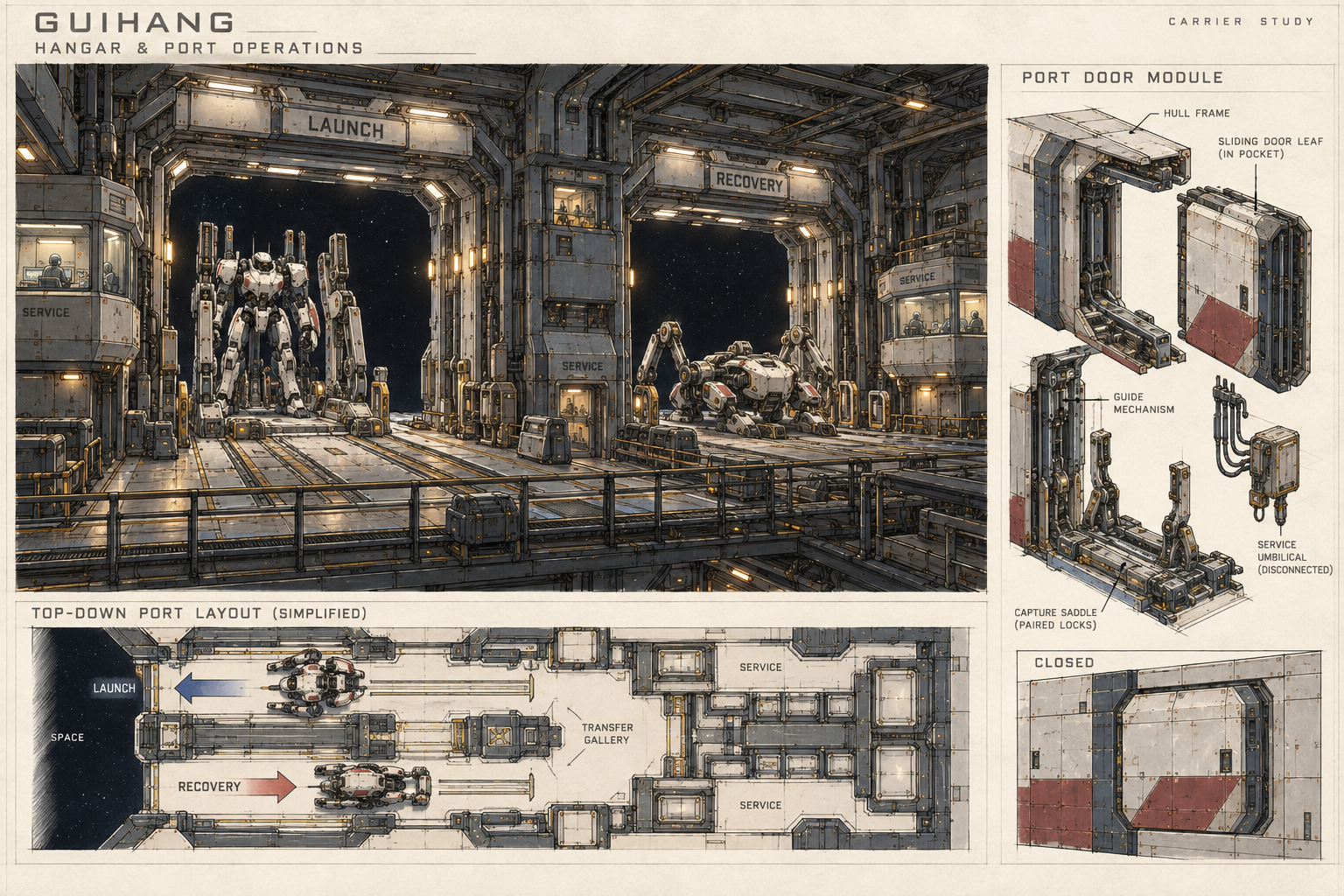
完整生成提示词 1 轮记录 · 原文
AI 图像创作记录 · 保留实际输入原文与修订顺序。
参考图:归航号母版:形体与双港口 · 探索、战斗与采集机体
参考图用于建立新图的设计关系;其自身的生成与修订记录可从对应图片查看。
Use case: stylized-concept. Create an original HAND-DRAWN industrial mecha concept-development sheet on ivory drafting paper, 1536x1024 landscape. Match input image 1, the GUIHANG mother ship master, as the authoritative exterior visual identity. Warm-white armor, slate blue-gray structure, graphite recesses, sparse brick-red identification, amber work lights. Crisp pencil/ink contour, light construction lines, controlled marker shadows. No photoreal CGI, no fantasy monument, no generic new ship or copied franchise, no fake dimension numbers, no unreadable handwritten paragraphs. These are concept views, not validated engineering projections. Preserve low bridge aft of center, short faceted bow, thick enclosed body, TWO port-side midship mouths separated by one thick pier (forward LAUNCH, aft RECOVERY), six aft engine apertures total in two columns of three, only short fins. Small figures in the reference are schematic, not exact scale evidence.
Input image 2 defines ORIGINAL shipborne machines: small nonhumanoid EXPLORER, armored humanoid SENTINEL, four-arm HARVESTER. Match their form family.
Asset: a hand-drawn HANGAR and PORT OPERATIONS design sheet, NOT a new exterior design.
Upper left dominant 60 percent: interior perspective looking from the aft maintenance gallery toward the port-side hull with TWO separate exterior openings visible, forward LAUNCH and aft RECOVERY, separated by a thick fixed pier. Through each opening is dark space without a giant planet. Put the humanoid in a supported launch cradle by one lane; put a folded four-arm harvester in the separate capture/inspection area, not blocking the launch lane. Clearly show outer service alcove, smaller machine transit throat, inner doors and their side parking pockets. Rails and clamp arms have actual mounting points. The machine is large relative to a HUMAN worker, at least ten times their height; humans only inside small PRESSURIZED service boxes behind windows, or in visibly tethered pressure suits. No casual people standing in vacuum, no stools or houseplants in open hangar.
Bottom left: one very simple TOP-DOWN block layout. Exterior/space is to left, interior maintenance to right. Two parallel routes through two separate gates: outgoing LAUNCH arrow to left, incoming RECOVERY arrow to right. Capture and unload sit only on the incoming line; shared transfer gallery at rear has a clear stop point, not overlapping through-traffic. Do not point both arrows outwards.
Right column: exploded detail of ONE sliding port-door module: outer frame attached to hull, thick sliding leaf displaced into its adjacent recessed pocket, guide mechanism, inner fixed capture saddle with paired locks, and service umbilical kept disconnected until capture. Small second inset shows the same door CLOSED flush. Only minimal labels LAUNCH / RECOVERY / SERVICE / DOOR MODULE / CLOSED.
Lighting concentrated on clamps and active lanes; some service bays dark and sealed. Show pressure boundaries as thick glass and local small airlocks, not a giant repeatedly pressurized hangar. No blueprint dimension claims, no free-floating parts except explicit exploded inset.
完整保留该手稿首次绘制到此版本的提示词原文。历史指令可能包含后来修改或图面尚未达成的要求,不代替概念评审。
这张图的永久记录 ↗主景将出击与回收分开,平面关系图补充内部转运。右侧研究门框、导向机构、捕获鞍座与服务接头。
机库首先需要让人理解自己在哪里:门外是宇宙,门内是固定架、轨道与服务设施;港口之后还有可去的库位,不能到门洞就结束空间。
机体背部或腹部的承载鞍座与托架相接,成对锁点承担固定,检修接头在机械固定完成后才接入。不同机体通过夹具和转接架使用共同接口,不要求外壳长成同一种形状。
一次出击与一次回收
跳转到“一次出击与一次回收”| 流程 | 设计中的动作顺序 |
|---|---|
| 出击 | 库位 → 检修放行 → 待放行位置 → 托架送至门口 → 外部航路清空 → 解除固定并离舰 |
| 回收 | 舰外等待 → 独立接近走廊 → 门内减速与捕获 → 机械锁定 → 检查/卸料 → 转运至维修库位 |
| 异常返回 | 牵引或拖带进入回收侧,固定后转入隔离与维修区,避免堵住正常出击线 |
离舰后先沿舷侧向外取得净空,再转向目的地。回收走廊与艉部推进喷流分开;两条航路和内部横向转运均需要调度,不能把平面上相交的轨道当成可同时自由通行。
门态与内部转运
跳转到“门态与内部转运”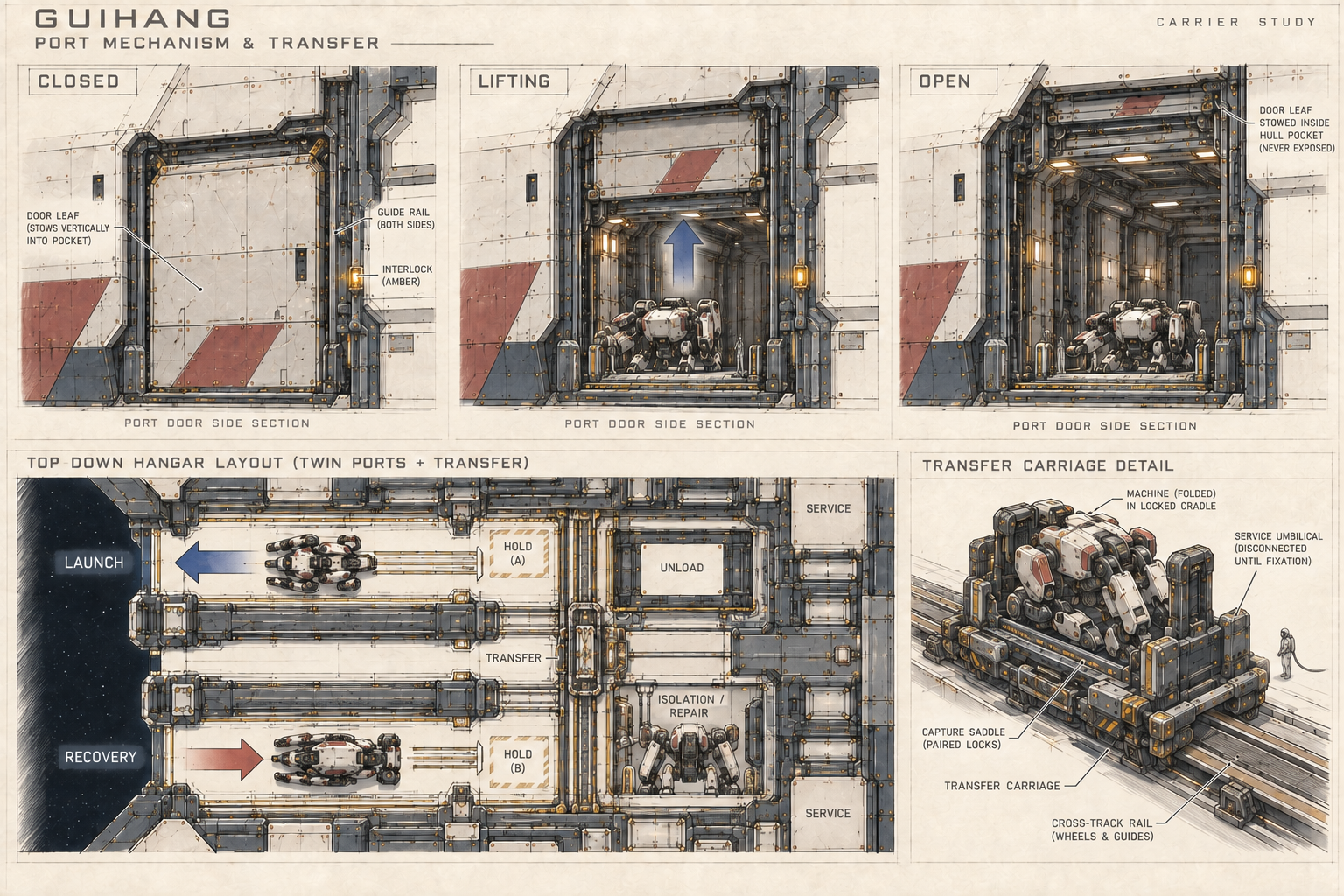
完整生成提示词 2 轮记录 · 原文
AI 图像创作记录 · 保留实际输入原文与修订顺序。
参考图:港口与机库 · 归航号母版:形体与双港口 · 探索、战斗与采集机体
参考图用于建立新图的设计关系;其自身的生成与修订记录可从对应图片查看。
Use case: stylized-concept. Draw a focused HAND-DRAWN PORT MECHANISM and TRANSFER concept sheet for the SAME GUIHANG twin side hangars in images 1 and 2, machines from image 3. Ivory paper, pencil/ink construction lines, warm-white/blue-gray/graphite and sparse brick-red, quiet marker shading. Landscape 1536x1024. This is explanatory concept design, not actual engineering certification.
Top half: THREE matching side-section panels of ONE MACHINE TRANSIT DOOR: CLOSED / LIFTING / OPEN. Commit to a clear ORIGINAL design refinement: one reinforced door leaf lifts VERTICALLY into a tall protected pocket directly ABOVE the same opening, guided by rails on both jambs. Show the complete pocket height and upper closed end, actual leaf remains INSIDE hull structure in the OPEN panel, never floating above hull. Door down blocks opening in CLOSED, halfway up in LIFTING, completely clear of the same vehicle transit opening in OPEN. One clean upward arrow for motion. Keep leaf thickness, opening dimensions and hardware consistent across the three panels. An amber interlock and fixed inner capture rail are present; leaf motion must not pass through the captured machine.
Bottom left 55 percent: legible TOP-DOWN floor/rail diagram of the SAME two independent side-facing lanes. Exterior space to LEFT; launch upper lane arrow outward LEFT; recovery lower lane arrow inward RIGHT. Both lanes end at one shared TRANSFER SHUTTLE track running vertically along their inboard ends. A mobile carriage on that cross-track transfers a LOCKED machine cradle between lane and maintenance berth; draw rails and carriage explicitly, not rail segments ending in empty space. Two clear HOLD marks ensure one machine movement at a time through shared transfer, not simultaneous crossing. Add dedicated UNLOAD pocket beside recovery and ISOLATION/REPAIR pocket beyond it, separated from the outgoing lane. Minimal labels LAUNCH / RECOVERY / TRANSFER / HOLD / UNLOAD / ISOLATION.
Bottom right: one perspective mechanical detail of the transfer carriage with a neutral folded machine locked on top, visible clamps, cross-rail wheels/guides and service connector still disconnected until fixation. Tiny suited human tethered nearby provides approximate scale only; no exact sizes.
Keep the two exterior ports and central structural pier consistent with prior sheets. The pressure boundary is the small service boxes, not the entire vacuum working hangar. NO mecha battle, no three exterior doors, no dimensions, no unrelated hull redesign or decorative background.
参考图:门机与横向转运 · 返修前初版
原调用编辑当时的同名图;执行前已将该输入另存为此处的-v1版本,避免引用返修后的结果作为自身输入。
Use case: precise-object-edit. Preserve this entire GUIHANG PORT MECHANISM & TRANSFER concept sheet: same three door states CLOSED/LIFTING/OPEN, lift guides, door geometry, same floor plan/colored arrows/HOLD A/B/transfer carriage/UNLOAD/ISOLATION labels, same original machines and details. Correct ONLY human scale. The machines are 10-12 meter workframes, the suited maintenance people are 1.75 meter tall at the SAME ground depth. In the lower-right TRANSFER CARRIAGE DETAIL, make the suited person much smaller: their height should be about ONE SIXTH the machine's uncradled body height, roughly ONE QUARTER their current drawn height. Keep boots contacting the same floor and tether visible. In the top LIFTING and OPEN door panels, similarly shrink the human figures beside the machine to ONE QUARTER their current height. They must read as tiny maintenance people beside a very large machine, never as ordinary people beside a 3 meter robot. Do not resize machines, doors, carriage or text. Preserve style/composition and all non-human parts. This is proportion correction, not new machine design.
完整保留该手稿首次绘制到此版本的提示词原文。历史指令可能包含后来修改或图面尚未达成的要求,不代替概念评审。
这张图的永久记录 ↗补充页增加 HOLD A/B、横向转运车、卸料区与隔离维修区。门片候选为垂直上提,收纳在舰壳内部的上方空间。
图上的三种门态说明运动意图,但它们仍主要是正面透视。尽管图中文字写有“侧剖”,这一页还没有真正剖开门片与收纳腔。 刚性门叶的终位、驱动机构以及它们与上层舱室的互斥空间,仍须用真侧剖补清,不能靠“收进船壳”一句话带过。
人物与机体的比例也尚未统一。局部修订改善了重型机体的体量感,但门内人物、转运细节和全舰视图之间仍有差异;不能从现图直接量取门宽、门高和拖带包络。
真空区与人的位置
跳转到“真空区与人的位置”机库按低重力、真空作业区研究。托架和轨道负责搬运,港内人员穿压力服并使用系留;普通人员停留在局部加压服务盒内,通过小气闸或密封通道进入工作位置。整座巨型机库不会为了每次出击反复充气。
这些边界应在后续图中继续保持:压力窗后的人、开放机库中的压力服人员和无人设备,各自有明确位置。它们也是将来的动画、音效与新手引导可以依赖的空间信息。