逐图生成提示词
这些手稿是 AI 图像创作与人工评审共同留下的记录。我们把实际输入的完整提示词与图像一起保存:既记录第一次如何描述,也记录每次返修如何改变它。展开图下的记录即可阅读或复制原文。
提示词保留原始语言。修订图按顺序列出初始输入与编辑指令,并注明参考图;同一提示词再次生成时,结果可能不同。
归航号母版:形体与双港口
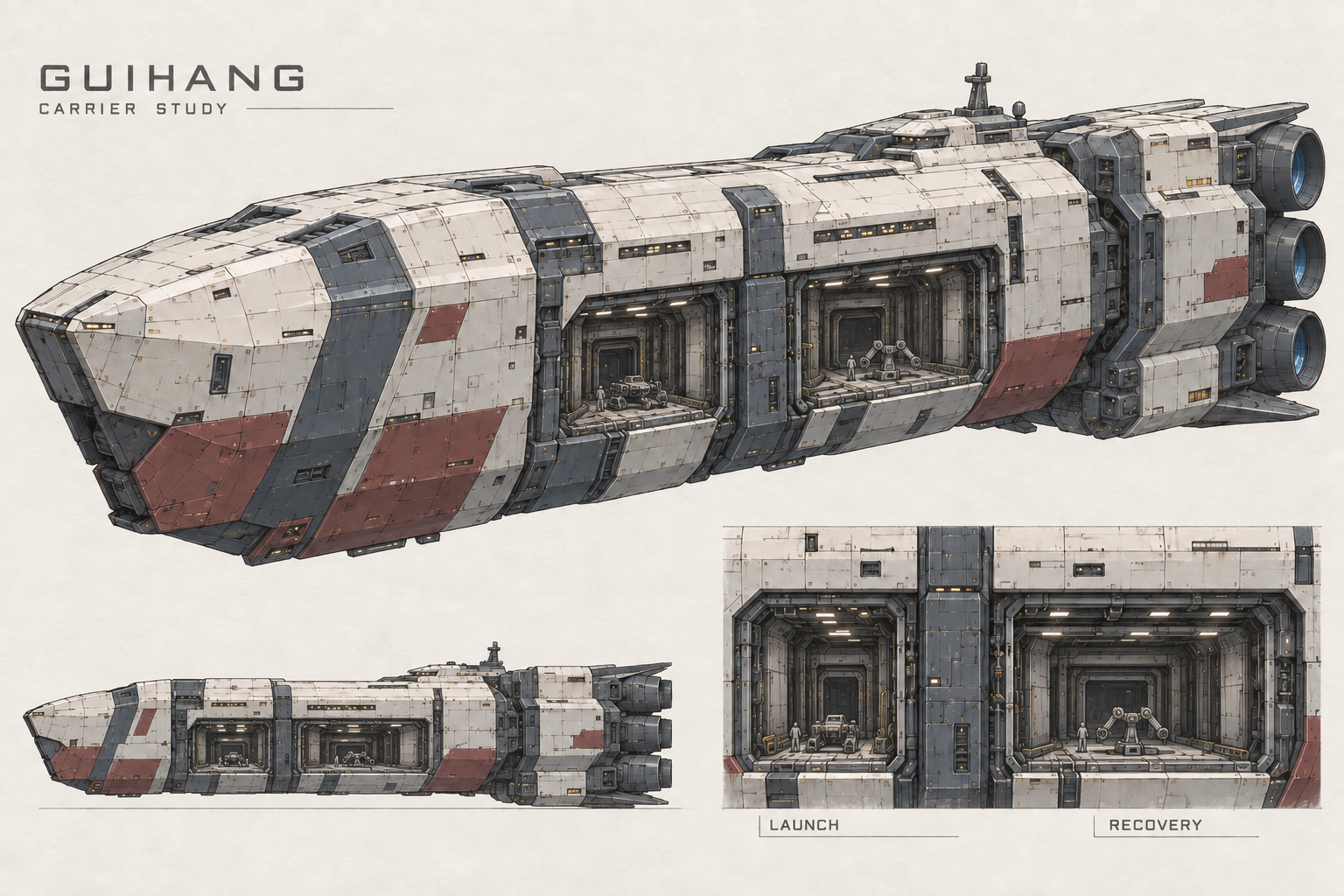
完整生成提示词 2 轮记录 · 原文
AI 图像创作记录 · 保留实际输入原文与修订顺序。
参考图:归航号工业舰船方向初稿
以早期工业舰方向图为编辑输入,转绘为母版手稿;这一步是本手稿的首次生成。
Use case: style-transfer.
Asset type: MASTER HAND-DRAWN CONCEPT SHEET for one original human space-ark carrier GUIHANG. Image 1 is the existing rough design to revise, not a finished ship.
User direction: grounded Mobile Suit Gundam-style naval mechanical design, restrained and handsome, no fantasy monument. FIRST CONCEPT SKETCHES, not Blender renders or final manufacturing drawings.
Revise these specific design weaknesses in the reference:
1. Keep its heavy enclosed long body, short faceted bow, warm-white / slate-blue / graphite / sparse brick-red palette. Replace the monotonous cargo-box profile with THREE clear connected masses: thick protected forward shoulder, slightly recessed midship service waist, broad aft engineering shoulders. These are substantial hull transitions, not wings or added spikes.
2. Make the command bridge a LOW compact semi-recessed armored island in the aft third. Remove the tall forest of naval antenna masts and the giant row of bridge windows. The ship is kilometer-class; fine grouped inhabited window lights must be tiny. Keep one short sensor mast.
3. On the visible PORT side of the midship service waist, clearly show TWO distinct rectangular recessed mouths side by side along the hull length, separated by a thick structural pier. The FORWARD mouth is LAUNCH; the AFT mouth is RECOVERY, a little wider. Actual dark tunnel depth, outer doors, inner framing and guides visible in BOTH mouths. These are side-facing, safely ahead of the stern thrusters. A tiny original humanoid mobile-frame in the launch cradle and a tiny four-arm industrial frame near the recovery mouth identify the carrier's role. No generic shuttle as the only payload.
4. The stern has SIX main engine apertures TOTAL, arranged as TWO columns of THREE, clearly built into sturdy structural modules. Fore-aft direction obvious. From the hero view only the near bank and part of the far bank need be visible. Small attitude thrusters and short cooling vanes; not giant fins.
5. Preserve a broad quiet sealed forebody for sleeping community, a thin grouped habitation band above the waist, dense service details only around the two ports, and separately colored aft machinery. A few replaced panels and dark sealed sectors imply a long life; no luxurious terraces or exposed parks.
Layout 1536x1024 landscape, tasteful HAND-DRAWN DESIGN SKETCH presentation on off-white paper. Top 70 percent: one complete revised mother ship in front-port three-quarter view, enough side visible to read both ports, generous margins. Bottom left 25 percent: small strict SIDE silhouette sketch of the SAME ship, showing the low bridge and three mass transitions. Bottom right 25 percent: enlarged mechanical detail of the SAME paired side ports with central divider, 20-meter-class mecha dwarfed by the doorway, thick opening rim and inner rail/capture frame. Labels ONLY "GUIHANG / CARRIER STUDY", "LAUNCH", "RECOVERY" in small restrained drafting typography. No fake handwritten paragraphs, no dimensions, no second ship alternative.
Style: professional original anime-mecha designer's exploratory pen/pencil and marker sheet, clean purposeful contour lines with subtle construction lines, restrained color blocking, crisp shaded angular surfaces, legible dark mechanical recesses. Beauty through proportions and controlled detail. NOT a photograph, CGI product render, stone building, rounded seed, crown, scythe, luxury liner or toy. Do not copy Archangel's split prow, any Gundam logo or any existing franchise ship. No gun batteries, space background, planets or bright engine bloom. This is a concept mother sheet, not a validated technical projection.
局部修订母版初稿;输入为保留的返修前版本。
Use case: precise-object-edit.
Image 1 is the edit target, a hand-drawn master sheet for the original GUIHANG mother ship. Retain the main ship's silhouette, materials, color placement, camera, page layout, title, three-level stern engine bank and low bridge. Make ONLY a coordinated drawing-consistency correction:
A. The lower-left side-view inset incorrectly lacks the two visible PORT side openings. Replace that small inset with a true PORT side elevation of the SAME hero ship: short angled bow, same low bridge position, same armored midship waist containing TWO rectangular mouths separated by the same broad vertical pier, forward mouth launch and aft mouth recovery. Same height and fore-aft positions relative to the body as the hero. Do not label the incorrect old drawing as another side.
B. In BOTH main hero and bottom-right port-detail inset, replace the recognizable colorful humanoid with a tiny neutral grey industrial humanoid scale placeholder and the industrial machine with a comparably small grey 4-arm placeholder. Their height must be about ONE FIFTH of each LARGE exterior service-bay aperture, NOT half. Preserve exactly the same relative size in hero and detail. Large exterior service alcoves are not themselves human-sized airlocks.
C. Deep inside each of these large exterior service mouths, clearly indicate a smaller framed machine transit throat, a supported guide/capture cradle and a visible heavy sliding panel parked in a side pocket. The vehicle remains about half the smaller inner transit throat's height. Use simple modular parallel guide structures, not a busy factory maze. The space between the paired mouths remains solid, structural and consistent in all views. The labels LAUNCH and RECOVERY remain attached to the correct corresponding mouths.
D. Keep the underlying drawing restrained and hand-drafted, with graphite and marker shading on warm paper; no dimension numbers, no invented diagrams, no additional vessels or labels, no change to the rest of the ship.
This is visual concept coherence, not engineering certification. Make the same object repeat faithfully across the sheet.
完整保留该手稿首次绘制到此版本的提示词原文。历史指令可能包含后来修改或图面尚未达成的要求,不代替概念评审。
这张图的永久记录 ↗同舰六视图研究
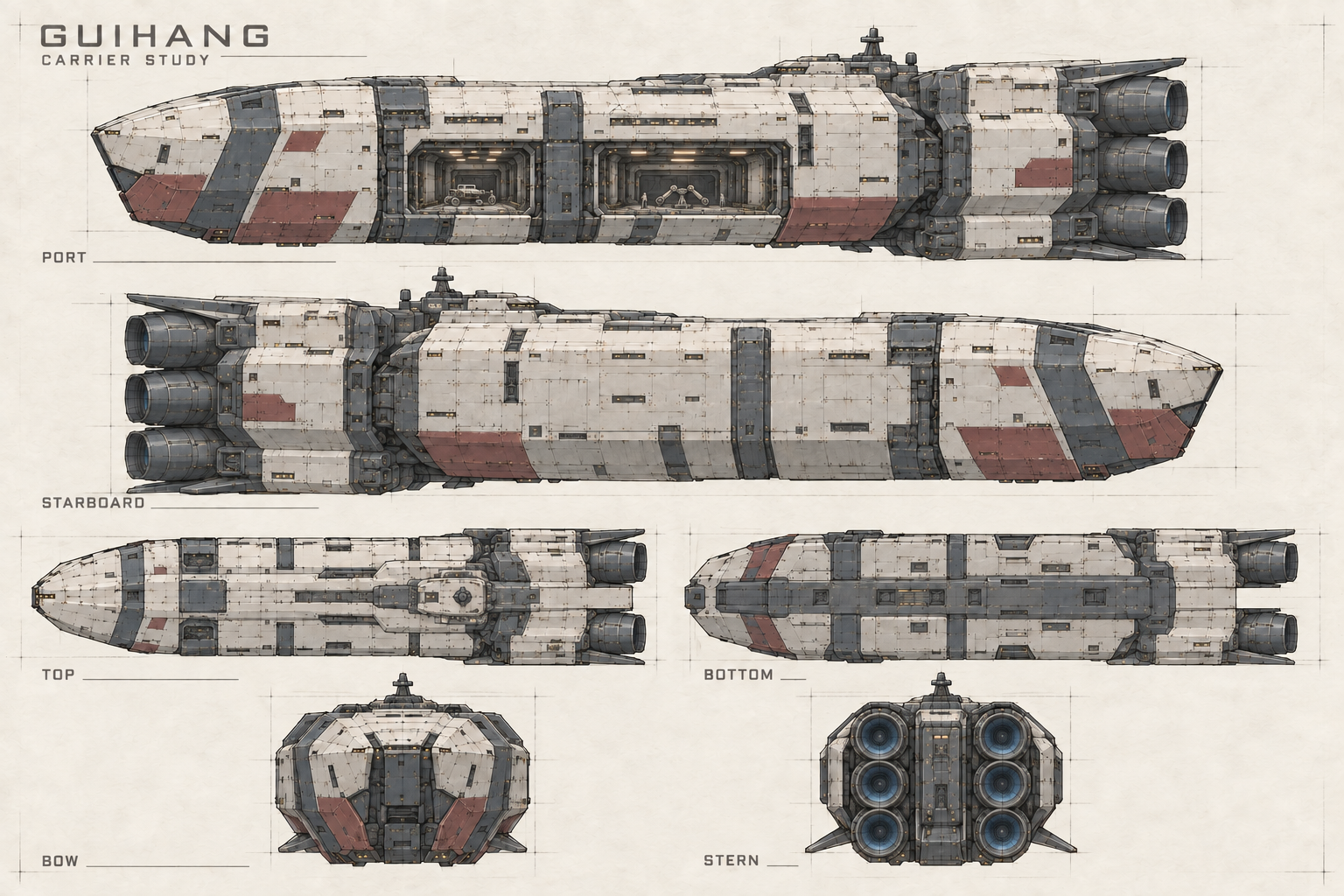
完整生成提示词 2 轮记录 · 原文
AI 图像创作记录 · 保留实际输入原文与修订顺序。
参考图:归航号母版:形体与双港口
参考图用于建立新图的设计关系;其自身的生成与修订记录可从对应图片查看。
Use case: stylized-concept. Create an original HAND-DRAWN industrial mecha concept-development sheet on ivory drafting paper, 1536x1024 landscape. Match input image 1, the GUIHANG mother ship master, as the authoritative exterior visual identity. Warm-white armor, slate blue-gray structure, graphite recesses, sparse brick-red identification, amber work lights. Crisp pencil/ink contour, light construction lines, controlled marker shadows. No photoreal CGI, no fantasy monument, no generic new ship or copied franchise, no fake dimension numbers, no unreadable handwritten paragraphs. These are concept views, not validated engineering projections. Preserve low bridge aft of center, short faceted bow, thick enclosed body, TWO port-side midship mouths separated by one thick pier (forward LAUNCH, aft RECOVERY), six aft engine apertures total in two columns of three, only short fins. Small figures in the reference are schematic, not exact scale evidence.
Asset: coherent six-view concept sheet of this SAME ship, not six alternatives. Layout top two rows each with two long horizontal ship views; bottom row with two end views and generous blank margins. Labels only PORT, STARBOARD, TOP, BOTTOM, BOW, STERN.
PORT: bow left, stern right, BOTH rectangular side service mouths visibly open at the midship waist, bridge in same aft position and three visible near-bank nozzles.
STARBOARD: mirror longitudinal orientation with bow right, stern left; opposite side is plated service access with CLOSED rectangular maintenance panels, no invented open garden or symmetric active hangar.
TOP: bow left and stern right, one central longitudinal spine, paired shoulder masses, compact low bridge, near-side hangar recess corresponding to PORT. BOTTOM: bow left and stern right, reinforced keel and maintenance hatches; no bridge and no duplicated dorsal details.
BOW: short faceted nose facing directly toward viewer, broad shoulder silhouette behind it and tiny centered bridge silhouette above; NO engine holes at the nose.
STERN: directly behind, exactly SIX main nozzles as two vertical columns of THREE circles; structure between columns, tiny bridge above. Do not turn them into four or eight.
All views in restrained mostly orthographic drawing language, no extreme perspective, line weight separates primary silhouette from panel detail. Keep the same bow slope, hull beam, bridge location, port longitudinal position and engine count across ALL views. Fill the page elegantly without overlap. Do not add decorative inset shapes or extra views.
参考图:同舰六视图研究 · 返修前初版
第一张参考图为待修订初稿;其他参考图按原调用顺序提供外形依据。
Use case: precise-object-edit. Image 1 is the edit target, an existing six-view GUIHANG hand-drawn concept sheet. Correct ONE cross-view error only. Keep PORT, STARBOARD, BOW and STERN views, all labels, colors, bow, bridge, openings, page layout and linework unchanged. The STERN correctly defines SIX main nozzles as TWO horizontal banks, each with THREE vertically stacked nozzles. In the TOP and BOTTOM views ONLY, the aft engine modules currently incorrectly read as THREE side-by-side nozzles. Redraw just their aft engine region so each plan projection shows exactly TWO parallel left/right engine housings and TWO visible topmost (for TOP) or bottommost (for BOTTOM) nozzle mouths. The other two nozzles in each vertical stack are hidden directly underneath/above in projection. Do not draw a third central main nozzle. Keep the overall engine-bank width and all upstream hull geometry consistent with the correct STERN view. These two corrected end regions must belong to the same six-nozzle machine. Preserve ivory paper and pencil/marker style. No new text, dimensions, variants or other edits.
完整保留该手稿首次绘制到此版本的提示词原文。历史指令可能包含后来修改或图面尚未达成的要求,不代替概念评审。
这张图的永久记录 ↗总体拆解与舱段剖面
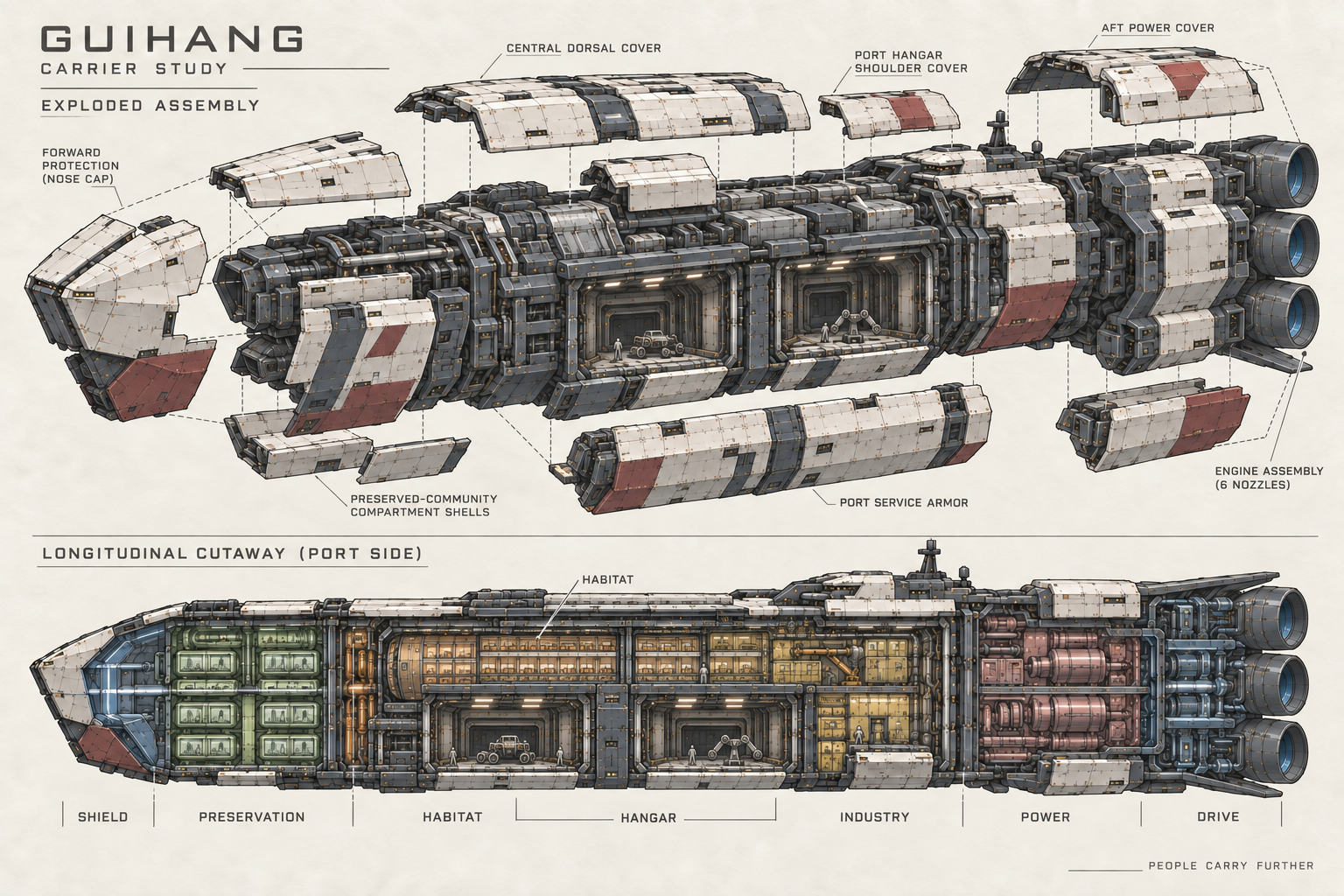
完整生成提示词 2 轮记录 · 原文
AI 图像创作记录 · 保留实际输入原文与修订顺序。
参考图:归航号母版:形体与双港口
参考图用于建立新图的设计关系;其自身的生成与修订记录可从对应图片查看。
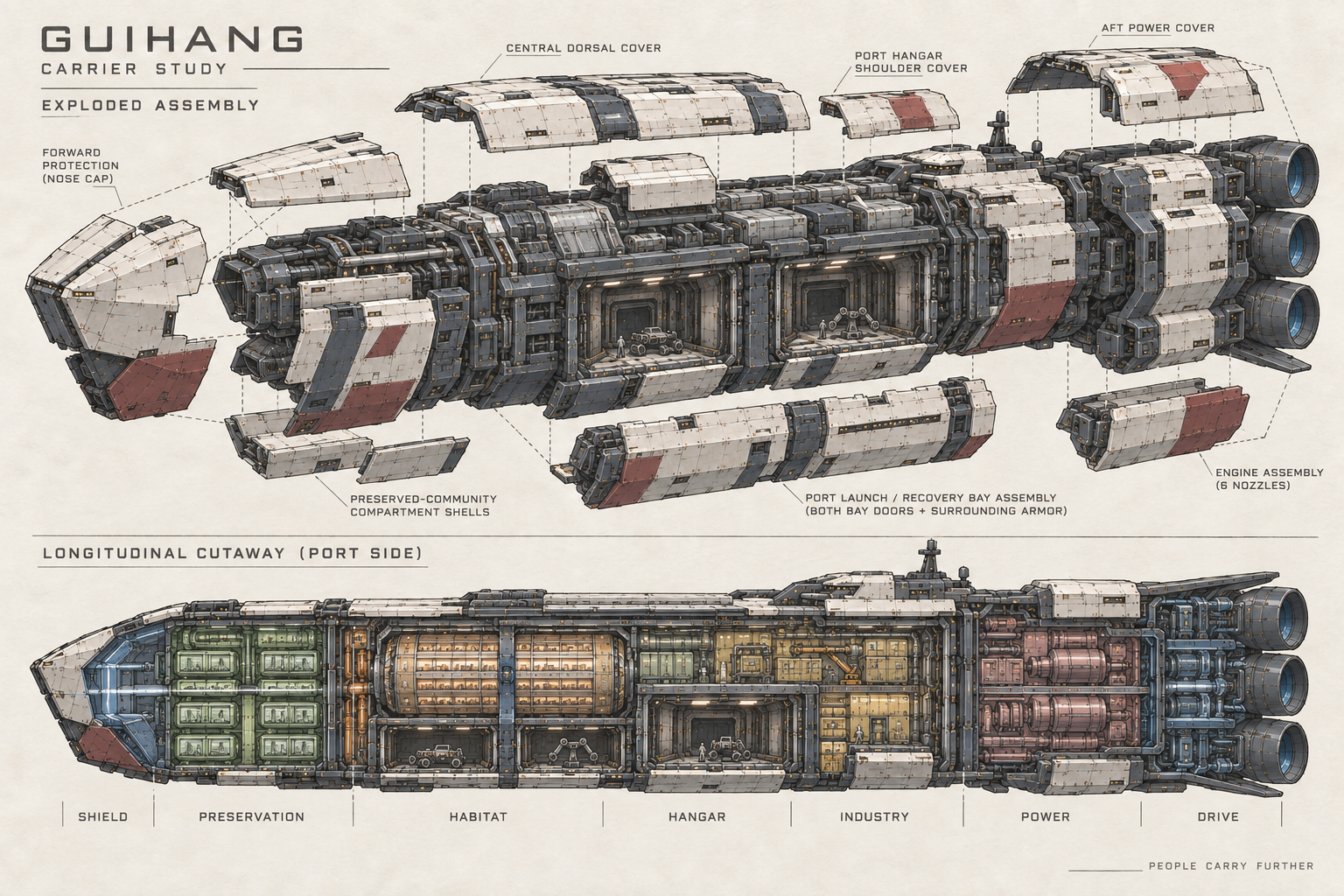
Use case: stylized-concept. Create an original HAND-DRAWN industrial mecha concept-development sheet on ivory drafting paper, 1536x1024 landscape. Match input image 1, the GUIHANG mother ship master, as the authoritative exterior visual identity. Warm-white armor, slate blue-gray structure, graphite recesses, sparse brick-red identification, amber work lights. Crisp pencil/ink contour, light construction lines, controlled marker shadows. No photoreal CGI, no fantasy monument, no generic new ship or copied franchise, no fake dimension numbers, no unreadable handwritten paragraphs. These are concept views, not validated engineering projections. Preserve low bridge aft of center, short faceted bow, thick enclosed body, TWO port-side midship mouths separated by one thick pier (forward LAUNCH, aft RECOVERY), six aft engine apertures total in two columns of three, only short fins. Small figures in the reference are schematic, not exact scale evidence.
Asset: clear hull decomposition and internal zoning CONCEPT study for the SAME mother ship.
Upper 60 percent: three-quarter EXPLODED ASSEMBLY drawing of the vessel with its coherent graphite structural backbone continuous. Lift only the major warm-white external armor sections slightly away with dotted guide lines: forward protection/nose cap, preserved-community compartment shells, central dorsal cover, port hangar shoulder cover, aft power cover. Keep both launch/recovery mouths together as a single side assembly. Aft complete engine assembly remains SIX nozzles, two columns of three. Explosion is modest and readable, not a cloud of random parts. Inner functional modules are large architectural volumes, not fully engineered reactors.
Lower 40 percent: same ship in PORT-side longitudinal CUTAWAY, bow left stern right. Clearly separate seven zones in this order and with tiny English labels only: SHIELD at bow, PRESERVATION with isolated sleeping/seed compartments forward, HABITAT inside protected midbody, HANGAR on port side of that region, INDUSTRY aft of habitats, POWER well aft, DRIVE at stern.
HABITAT is an ENCLOSED rotating-drum candidate INSIDE the hull, longitudinal axis, located inward and toward starboard from the port hangar. Show its curved residential decks as an internal module, not an enormous ring sticking out of the exterior or a floating garden. Central service spine is nonrotating. Hangar side module occupies a DISTINCT volume, not drawn through the residential drum. Show a simple separation between life/preservation systems and aft power volume. Front preserved-community blocks have redundancy, not one fragile glowing crystal.
Keep the open twin side bays in the same place as the exterior and the bridge small. Use lightly differentiated muted tints for zones and solid simple structural interfaces. No energy magic, no giant fuel flames, no arbitrary rooms whose scale pretends to be validated. Show how the parts relate; no numerical measurements.
参考图:总体拆解与舱段剖面 · 返修前初版 · 归航号母版:形体与双港口
第一张参考图为待修订初稿;其他参考图按原调用顺序提供外形依据。
Use case: precise-object-edit. Image 1 is the exploded/cutaway target. Image 2 is the authoritative exterior master of the SAME GUIHANG ship. Keep the upper exploded main ship and the overall page, design language, coloring and zones. Correct these exact inconsistencies:
1. LOWER longitudinal cutaway currently shows THREE open hangar rooms. Rebuild that LOCAL midship region to show exactly TWO port-side working openings and ONE thick pier in between, at the same longitudinal positions as image 2. Do NOT merely close the last opening: the current two forward rooms are wrongly packed too far forward. The FORWARD launch opening must span roughly the 28–41 percent section of ship length and the AFT recovery opening roughly 44–64 percent, visually aligned to the reference; percentages are instructions, NOT numbers to draw. Reorganize internal equipment to fit those two bays. Do not put a new third bay under INDUSTRY.
2. The protected rotating-habitat candidate is behind/inboard of those two bays, and upper occupied decks may be visible above them, but the HANGAR label must bracket BOTH existing side bays and HABITAT should use a leader to the inner/upper habitation volume. Keep SHIELD, PRESERVATION, INDUSTRY, POWER, DRIVE labels with their actual regions. Don't add exterior rings.
3. In UPPER exploded view, the text ENGINE ASSEMBLY (6 NOZZLES) currently points to an ordinary detached armor panel. Move its leader clearly to the assembled aft nozzle cluster; the detached plate is just armor, not a propulsion unit. Keep six nozzle total and all key exterior identity.
4. Do not present the detached flat side cladding as though it itself contains working doors; caption it PORT SERVICE ARMOR. The underlying paired bay structure stays connected to the spine.
Preserve clear hand-drawn ink and restrained marker on ivory paper, exact original ship identity, no new styles or dimension claims. Fix the diagram, not merely its prose.
完整保留该手稿首次绘制到此版本的提示词原文。历史指令可能包含后来修改或图面尚未达成的要求,不代替概念评审。
这张图的永久记录 ↗港口与机库
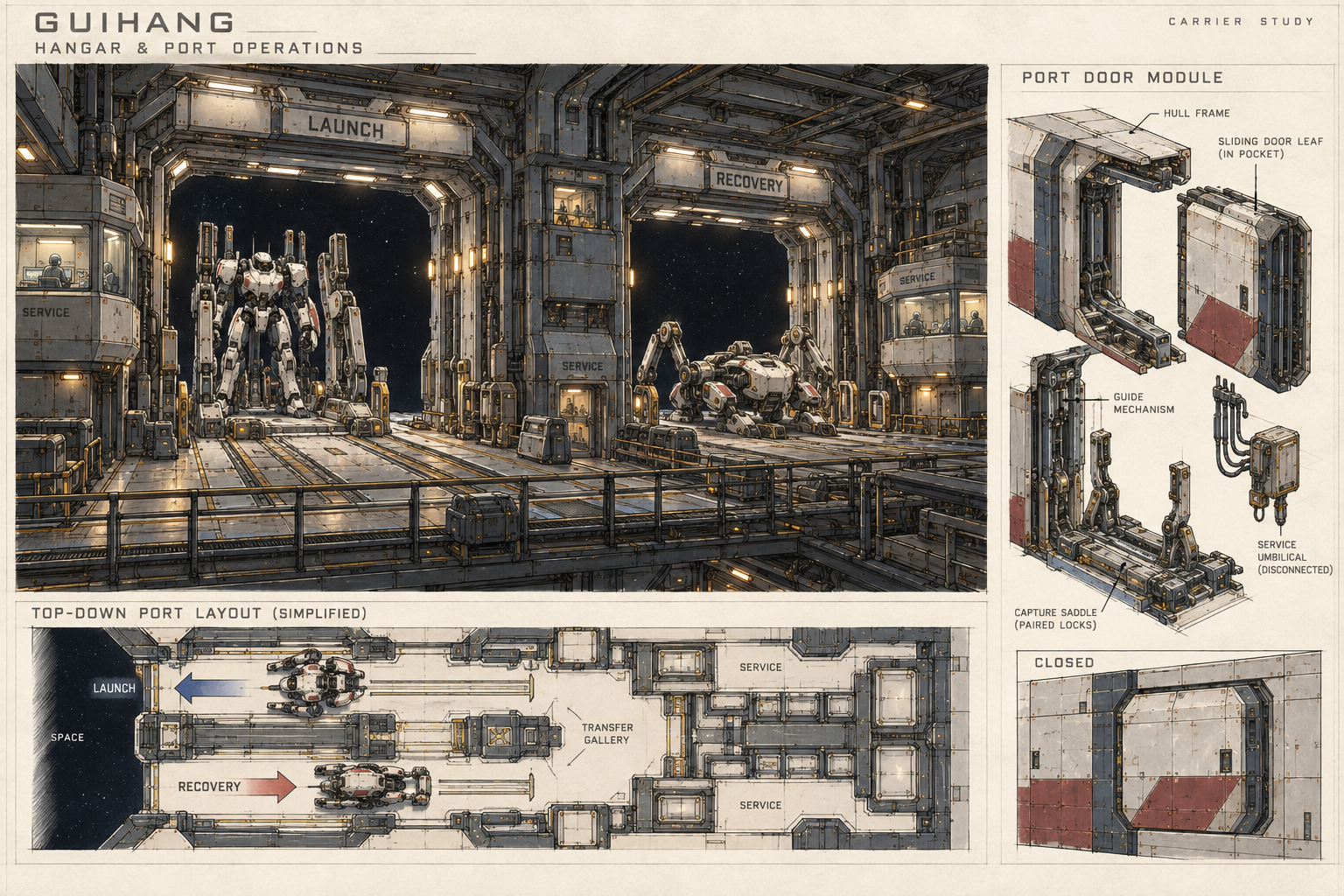
完整生成提示词 1 轮记录 · 原文
AI 图像创作记录 · 保留实际输入原文与修订顺序。
参考图:归航号母版:形体与双港口 · 探索、战斗与采集机体
参考图用于建立新图的设计关系;其自身的生成与修订记录可从对应图片查看。
Use case: stylized-concept. Create an original HAND-DRAWN industrial mecha concept-development sheet on ivory drafting paper, 1536x1024 landscape. Match input image 1, the GUIHANG mother ship master, as the authoritative exterior visual identity. Warm-white armor, slate blue-gray structure, graphite recesses, sparse brick-red identification, amber work lights. Crisp pencil/ink contour, light construction lines, controlled marker shadows. No photoreal CGI, no fantasy monument, no generic new ship or copied franchise, no fake dimension numbers, no unreadable handwritten paragraphs. These are concept views, not validated engineering projections. Preserve low bridge aft of center, short faceted bow, thick enclosed body, TWO port-side midship mouths separated by one thick pier (forward LAUNCH, aft RECOVERY), six aft engine apertures total in two columns of three, only short fins. Small figures in the reference are schematic, not exact scale evidence.
Input image 2 defines ORIGINAL shipborne machines: small nonhumanoid EXPLORER, armored humanoid SENTINEL, four-arm HARVESTER. Match their form family.
Asset: a hand-drawn HANGAR and PORT OPERATIONS design sheet, NOT a new exterior design.
Upper left dominant 60 percent: interior perspective looking from the aft maintenance gallery toward the port-side hull with TWO separate exterior openings visible, forward LAUNCH and aft RECOVERY, separated by a thick fixed pier. Through each opening is dark space without a giant planet. Put the humanoid in a supported launch cradle by one lane; put a folded four-arm harvester in the separate capture/inspection area, not blocking the launch lane. Clearly show outer service alcove, smaller machine transit throat, inner doors and their side parking pockets. Rails and clamp arms have actual mounting points. The machine is large relative to a HUMAN worker, at least ten times their height; humans only inside small PRESSURIZED service boxes behind windows, or in visibly tethered pressure suits. No casual people standing in vacuum, no stools or houseplants in open hangar.
Bottom left: one very simple TOP-DOWN block layout. Exterior/space is to left, interior maintenance to right. Two parallel routes through two separate gates: outgoing LAUNCH arrow to left, incoming RECOVERY arrow to right. Capture and unload sit only on the incoming line; shared transfer gallery at rear has a clear stop point, not overlapping through-traffic. Do not point both arrows outwards.
Right column: exploded detail of ONE sliding port-door module: outer frame attached to hull, thick sliding leaf displaced into its adjacent recessed pocket, guide mechanism, inner fixed capture saddle with paired locks, and service umbilical kept disconnected until capture. Small second inset shows the same door CLOSED flush. Only minimal labels LAUNCH / RECOVERY / SERVICE / DOOR MODULE / CLOSED.
Lighting concentrated on clamps and active lanes; some service bays dark and sealed. Show pressure boundaries as thick glass and local small airlocks, not a giant repeatedly pressurized hangar. No blueprint dimension claims, no free-floating parts except explicit exploded inset.
完整保留该手稿首次绘制到此版本的提示词原文。历史指令可能包含后来修改或图面尚未达成的要求,不代替概念评审。
这张图的永久记录 ↗门机与横向转运
完整生成提示词 2 轮记录 · 原文
AI 图像创作记录 · 保留实际输入原文与修订顺序。
参考图:港口与机库 · 归航号母版:形体与双港口 · 探索、战斗与采集机体
参考图用于建立新图的设计关系;其自身的生成与修订记录可从对应图片查看。
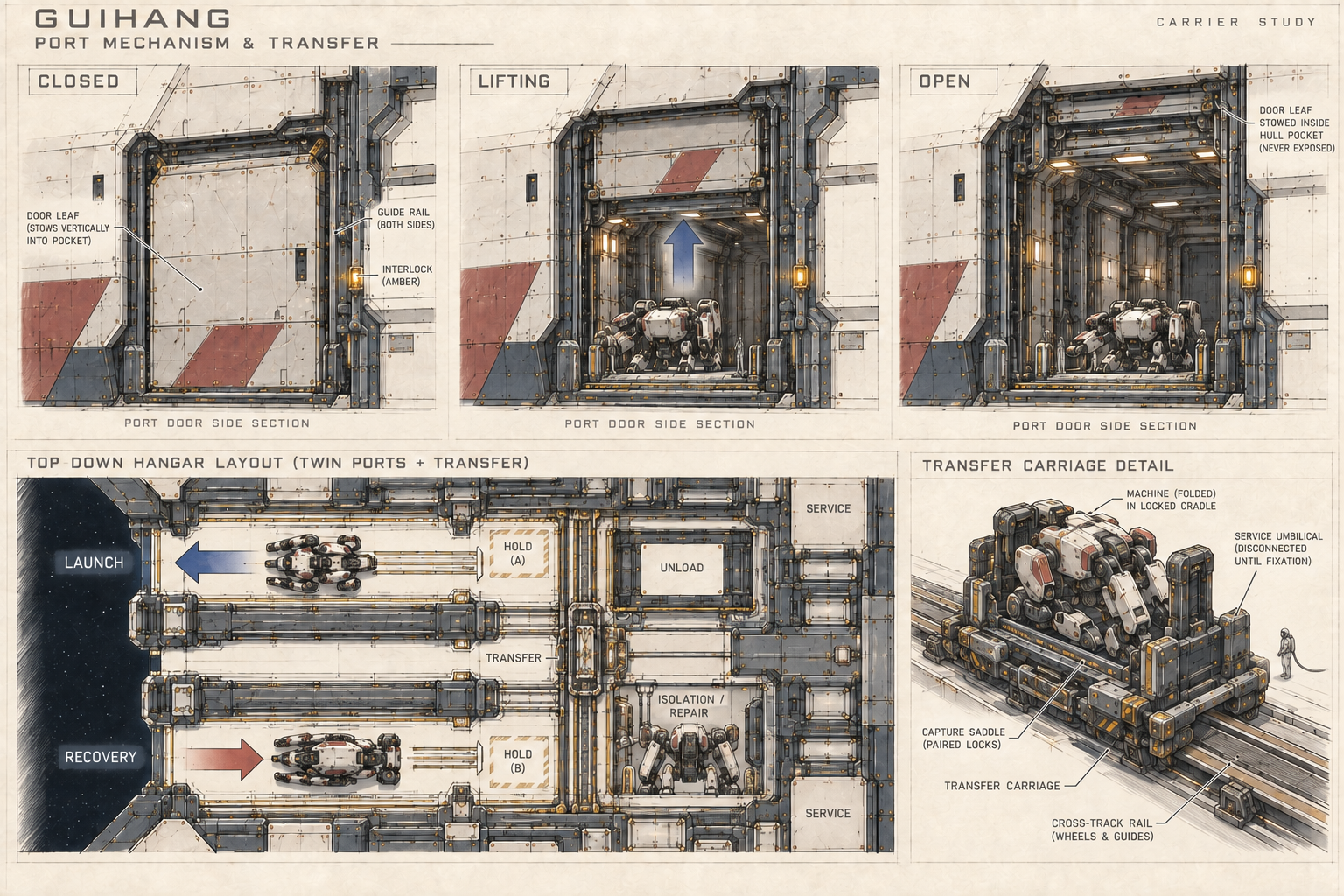
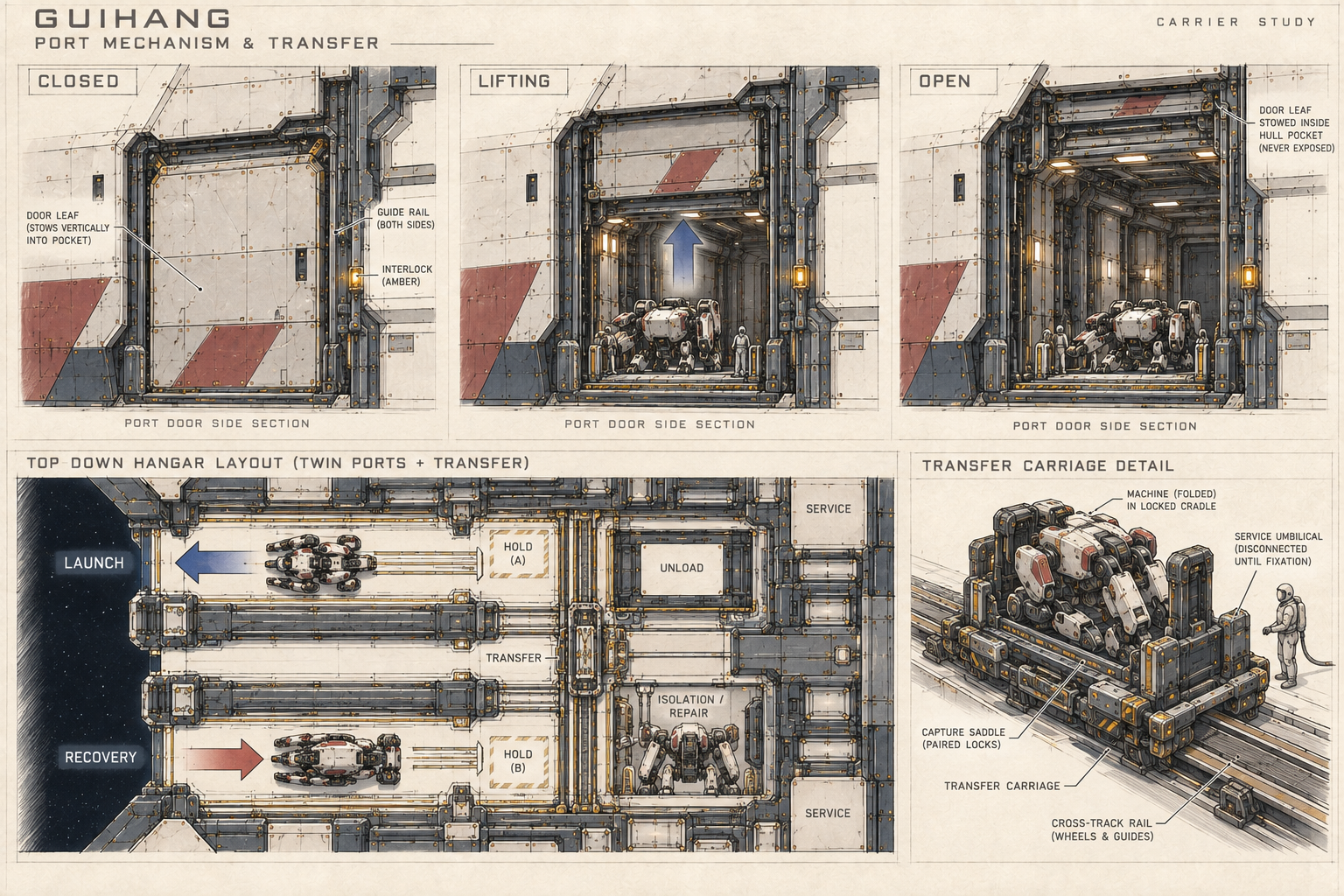
Use case: stylized-concept. Draw a focused HAND-DRAWN PORT MECHANISM and TRANSFER concept sheet for the SAME GUIHANG twin side hangars in images 1 and 2, machines from image 3. Ivory paper, pencil/ink construction lines, warm-white/blue-gray/graphite and sparse brick-red, quiet marker shading. Landscape 1536x1024. This is explanatory concept design, not actual engineering certification.
Top half: THREE matching side-section panels of ONE MACHINE TRANSIT DOOR: CLOSED / LIFTING / OPEN. Commit to a clear ORIGINAL design refinement: one reinforced door leaf lifts VERTICALLY into a tall protected pocket directly ABOVE the same opening, guided by rails on both jambs. Show the complete pocket height and upper closed end, actual leaf remains INSIDE hull structure in the OPEN panel, never floating above hull. Door down blocks opening in CLOSED, halfway up in LIFTING, completely clear of the same vehicle transit opening in OPEN. One clean upward arrow for motion. Keep leaf thickness, opening dimensions and hardware consistent across the three panels. An amber interlock and fixed inner capture rail are present; leaf motion must not pass through the captured machine.
Bottom left 55 percent: legible TOP-DOWN floor/rail diagram of the SAME two independent side-facing lanes. Exterior space to LEFT; launch upper lane arrow outward LEFT; recovery lower lane arrow inward RIGHT. Both lanes end at one shared TRANSFER SHUTTLE track running vertically along their inboard ends. A mobile carriage on that cross-track transfers a LOCKED machine cradle between lane and maintenance berth; draw rails and carriage explicitly, not rail segments ending in empty space. Two clear HOLD marks ensure one machine movement at a time through shared transfer, not simultaneous crossing. Add dedicated UNLOAD pocket beside recovery and ISOLATION/REPAIR pocket beyond it, separated from the outgoing lane. Minimal labels LAUNCH / RECOVERY / TRANSFER / HOLD / UNLOAD / ISOLATION.
Bottom right: one perspective mechanical detail of the transfer carriage with a neutral folded machine locked on top, visible clamps, cross-rail wheels/guides and service connector still disconnected until fixation. Tiny suited human tethered nearby provides approximate scale only; no exact sizes.
Keep the two exterior ports and central structural pier consistent with prior sheets. The pressure boundary is the small service boxes, not the entire vacuum working hangar. NO mecha battle, no three exterior doors, no dimensions, no unrelated hull redesign or decorative background.
参考图:门机与横向转运 · 返修前初版
原调用编辑当时的同名图;执行前已将该输入另存为此处的-v1版本,避免引用返修后的结果作为自身输入。
Use case: precise-object-edit. Preserve this entire GUIHANG PORT MECHANISM & TRANSFER concept sheet: same three door states CLOSED/LIFTING/OPEN, lift guides, door geometry, same floor plan/colored arrows/HOLD A/B/transfer carriage/UNLOAD/ISOLATION labels, same original machines and details. Correct ONLY human scale. The machines are 10-12 meter workframes, the suited maintenance people are 1.75 meter tall at the SAME ground depth. In the lower-right TRANSFER CARRIAGE DETAIL, make the suited person much smaller: their height should be about ONE SIXTH the machine's uncradled body height, roughly ONE QUARTER their current drawn height. Keep boots contacting the same floor and tether visible. In the top LIFTING and OPEN door panels, similarly shrink the human figures beside the machine to ONE QUARTER their current height. They must read as tiny maintenance people beside a very large machine, never as ordinary people beside a 3 meter robot. Do not resize machines, doors, carriage or text. Preserve style/composition and all non-human parts. This is proportion correction, not new machine design.
完整保留该手稿首次绘制到此版本的提示词原文。历史指令可能包含后来修改或图面尚未达成的要求,不代替概念评审。
这张图的永久记录 ↗紧凑指挥舰桥
完整生成提示词 1 轮记录 · 原文
AI 图像创作记录 · 保留实际输入原文与修订顺序。
参考图:归航号母版:形体与双港口
参考图用于建立新图的设计关系;其自身的生成与修订记录可从对应图片查看。
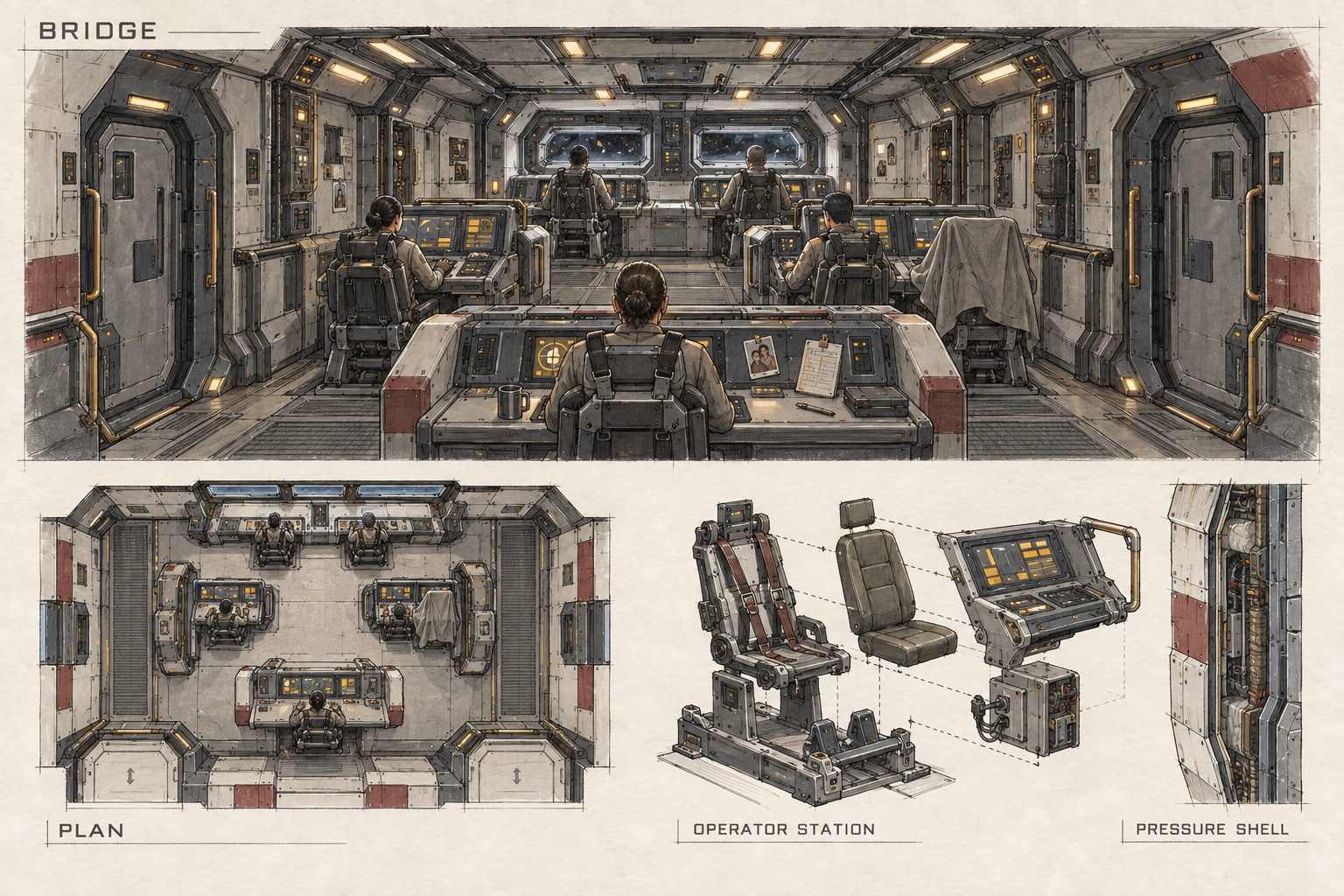
Use case: stylized-concept. Create an original professional HAND-DRAWN CONCEPT sheet, 1536x1024 landscape, ivory paper, crisp pencil/ink, light construction lines, restrained colored markers. Same design family as the GUIHANG mother ship in input image 1: warm-white panels, blue-gray thick structure, graphite mechanical recesses, sparse brick-red identity blocks, local amber work lights, serviceable modular parts. No photoreal CGI, no generic luxury spacecraft, no random glowing holograms, no dimension claims, no dense fake text. This is concept development before Blender, not an engineering drawing.
Asset: the compact protected COMMAND BRIDGE inside the small aft command island of this exact ship. Upper 65 percent is one rich interior perspective from the rear looking forward. Six to eight functional workstations in a modest room, not an auditorium. Two forward navigation/port-control seats, four midroom operator consoles, one compact aft coordination desk. Small thick recessed observation windows, more emphasis on physical inset instrument panels and clean limited displays than giant panoramic glass. UI is abstract quiet blocks, no readable paragraphs. Rigid seat frames with lap/shoulder restraints, foot captures and grabrails make axial LOW-GRAVITY operation legible. Crew are seated and restrained or attached to rails, no free-standing coffee cups. Walk/handhold passages at both sides, two identifiable rear pressure doors and a maintenance access hatch. Warm light on faces, equipment lights subtle. One inactive station under a fabric cover, a tiny clipped personal photograph and an unfinished shift card give human history.
Bottom left: simple top-down PLAN of the SAME room with matching seat count, forward window strip, side passages and two aft doors.
Bottom right: exploded side-detail of ONE operator station in four visually connected layers: structural pedestal/foot restraint, seat frame and harness, cushioning, hinged control console and under-seat service connector; plus a tiny wall slice showing outside armor, pressure shell and inner equipment lining. Parts have dotted assembly lines; no invented zero-g chair floating without mounts.
Labels only BRIDGE / PLAN / OPERATOR STATION / PRESSURE SHELL. Preserve a restrained naval industrial mood; people are small and ordinary, no franchise uniforms or emblems.
完整保留该手稿首次绘制到此版本的提示词原文。历史指令可能包含后来修改或图面尚未达成的要求,不代替概念评审。
这张图的永久记录 ↗公共生活舱与旋转段
完整生成提示词 2 轮记录 · 原文
AI 图像创作记录 · 保留实际输入原文与修订顺序。
参考图:归航号母版:形体与双港口
参考图用于建立新图的设计关系;其自身的生成与修订记录可从对应图片查看。
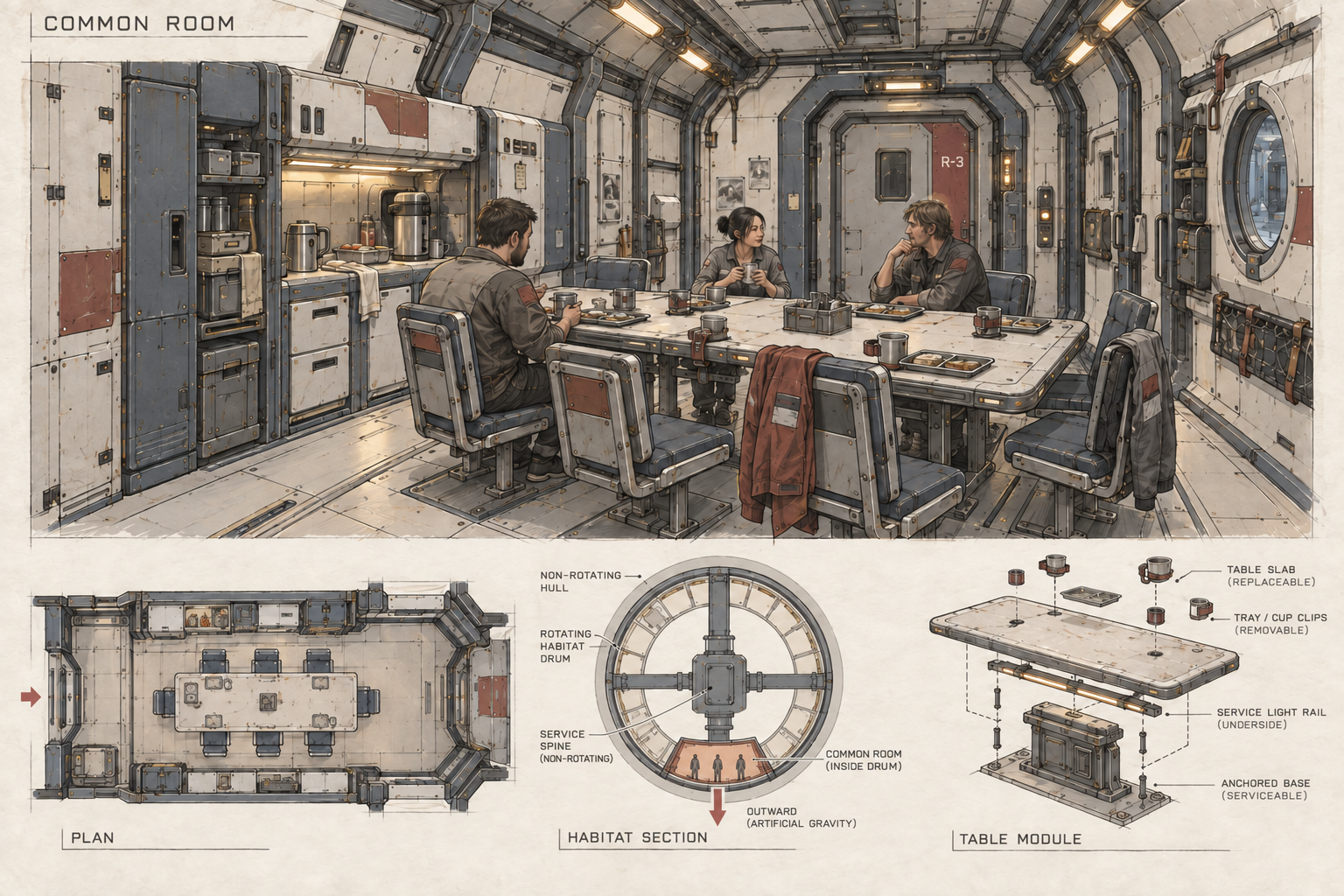
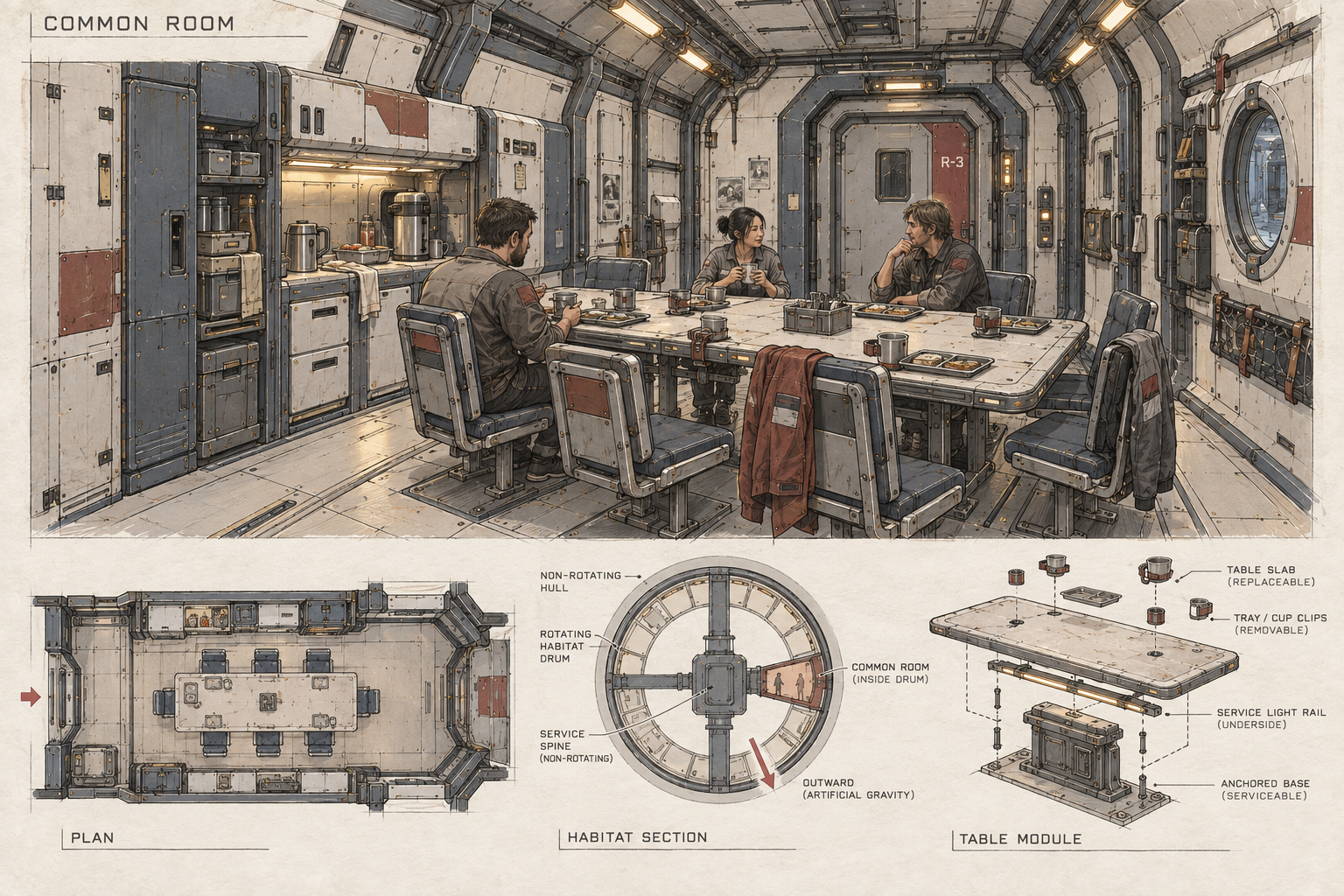
Use case: stylized-concept. Create an original professional HAND-DRAWN CONCEPT sheet, 1536x1024 landscape, ivory paper, crisp pencil/ink, light construction lines, restrained colored markers. Same design family as the GUIHANG mother ship in input image 1: warm-white panels, blue-gray thick structure, graphite mechanical recesses, sparse brick-red identity blocks, local amber work lights, serviceable modular parts. No photoreal CGI, no generic luxury spacecraft, no random glowing holograms, no dimension claims, no dense fake text. This is concept development before Blender, not an engineering drawing.
Asset: a communal room inside the ark's enclosed ROTATING HABITAT candidate, intimate human life, not a luxury liner. Upper 65 percent: one human-eye-level interior perspective. A long narrow modular room with subtle curved deck and repeating structural ribs, eight seats around one shared table, seven simple meal settings, a food-service niche, storage wall and an ordinary sealed door leading to an unawakened residential sector. No huge exterior window: room is deep inside protected hull. Small porthole into another pressurized circulation corridor only. Lit active half uses warm white panels, worn composite tabletop, fabric acoustic pads and a few repaired cup straps; closed sector beyond the far door stays cool and quiet. Show two or three ordinary crew in maintenance clothes sharing work/food, no royalty, no magic technology. Trays and cups have modest anti-spill clips. A folded garment and a repaired textile sleeve make it feel like a lived-in home. Thin brick-red door identification panel, physically attached rail lights.
Bottom left: plain PLAN, eight-seat table in center, service niche and lockers along one wall, entry on one end and sealed sector door opposite. Plan must match main perspective rather than invent another room.
Bottom center: tiny section diagram showing the room on the INNER curved deck of an ENCLOSED rotating drum inside a nonrotating hull. Its floor's outward radial direction is clear. A central nonrotating service spine and a small controlled transfer vestibule are distinct; do not connect ordinary doors directly between incompatible rotating structures. This is a schematic conceptual relationship, not solved bearings.
Bottom right: exploded TABLE assembly with anchored serviceable base, replaceable slab, removable tray/cup clips, underside service-light rail, dotted assembly guides. No houseplants, decorative trees, chandeliers, glass city dome or balconies.
Labels only COMMON ROOM / PLAN / HABITAT SECTION / TABLE MODULE. Mood: a few people slowly bringing a vast ship back to life.
原调用编辑当时的同名图;执行前已将该输入另存为此处的-v1版本,避免引用返修后的结果作为自身输入。
Use case: precise-object-edit. Edit ONLY the small circular HABITAT SECTION diagram at bottom center of this concept sheet. Preserve the large common-room perspective, bottom-left floor plan, bottom-right table exploded detail, color, ink/marker style and all other content. The orange COMMON ROOM sector is currently on the right of the ring, while its people stand vertically: this contradicts radial outward gravity. Move the orange common room sector to the SIX O'CLOCK BOTTOM part of the circular habitat drum. Draw its people standing on the OUTER bottom arc floor, FEET DOWN toward the ring's exterior and HEADS UP toward its center. Place a single radial OUTWARD (ARTIFICIAL GRAVITY) arrow straight down from this bottom room toward the outside of the ring, avoiding people. Relocate COMMON ROOM (INSIDE DRUM) leader to this bottom orange sector. Keep non-rotating outer hull and service spine, rotating habitat drum identities clear, remove the old orange room on the right. All large interior design and page layout remain unchanged. This is a hand-drawn concept section, not an engineering approval.
完整保留该手稿首次绘制到此版本的提示词原文。历史指令可能包含后来修改或图面尚未达成的要求,不代替概念评审。
这张图的永久记录 ↗探索、战斗与采集机体
完整生成提示词 1 轮记录 · 原文
AI 图像创作记录 · 保留实际输入原文与修订顺序。
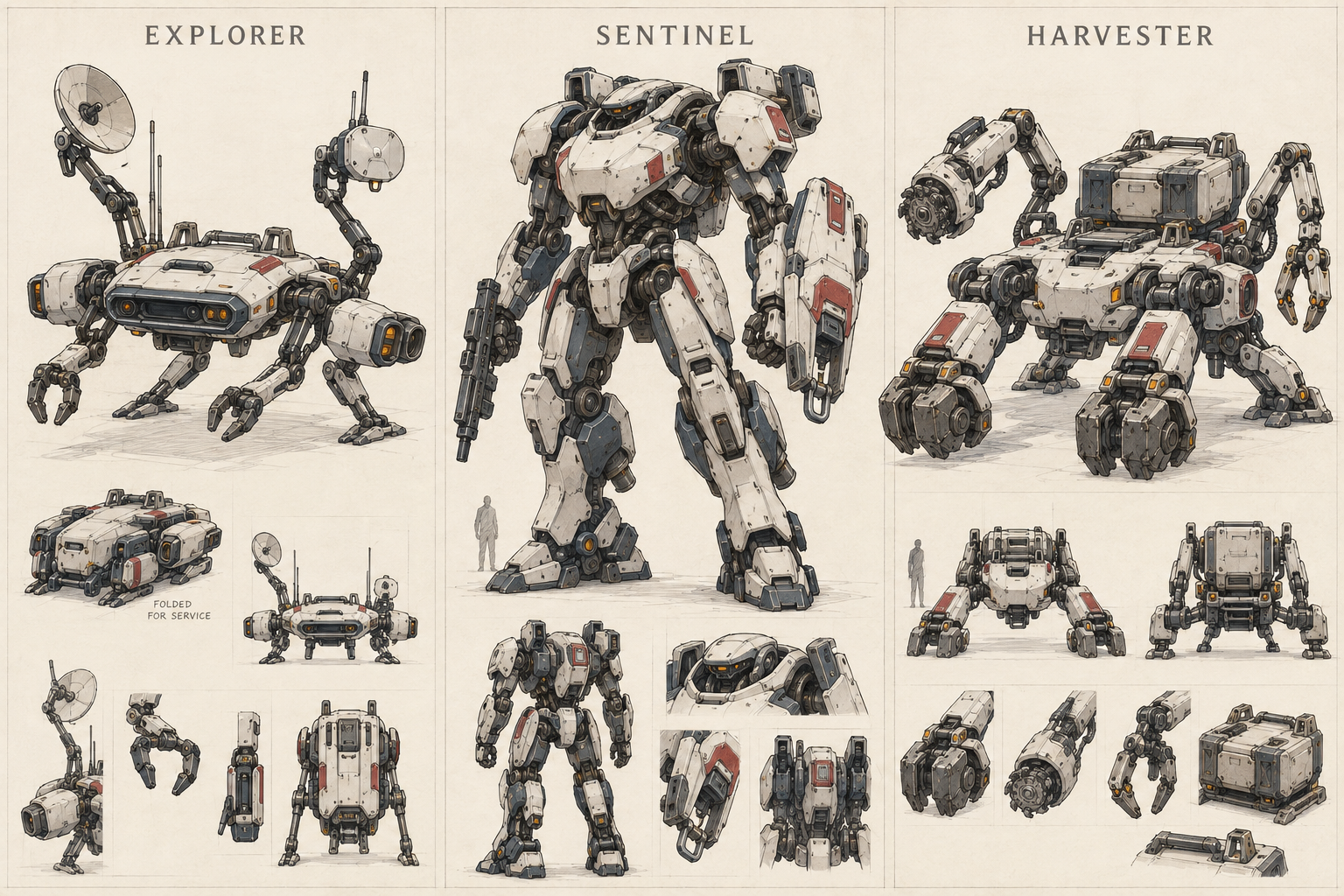
Use case: stylized-concept. Asset type: HAND-DRAWN CONCEPT MASTER for three original shipborne machine roles belonging to the human ark GUIHANG, not a finished game render.
Make one coherent professional Japanese mecha design sheet on ivory drafting paper, 1536x1024 landscape, three clear columns with full-body three-quarter drawings and generous margins. Precise pencil/ink contour, subtle construction lines, restrained marker colors, lively yet legible mechanical design. Main palette shared with mother ship: warm-white armor, slate blue-gray frame, dark graphite flexible depths, sparse brick-red identity panels and amber service catches. Tiny neutral human scale silhouettes, no exact dimensions or fake technical paragraphs. Labels only EXPLORER / SENTINEL / HARVESTER.
LEFT EXPLORER: non-humanoid compact observation machine. Low flat sensory torso, one recessed horizontal optical sensor bar, two articulated survey outriggers with dish/antenna ends, two compact sampling claws under the body, tiny vectoring thrust pods, short docking skids. No conventional airplane nose or wings, no full human legs, no cartoon face. Frame can fold into a small serviced package. Delicate and precise, clear instrument modules, no gun.
CENTER SENTINEL: original 20-meter-class humanoid protective combat/work frame. Synthesize layered industrial mecha skeleton, elegant wrapping chest/forearm armor and role-specific maneuvering equipment into ONE original coherent design. Low flattened faceless sensor head recessed in a high protective collar, NO forehead horns or V-fin. Forward-wrapping rounded chest shell over mechanical rib cage, protective shoulder roots with visible elbow/knee mechanisms, balanced waist, strong but relatively agile legs, short broad feet. Two compact replaceable back-thruster pods, small calf nozzles; no huge wings. Left forearm has an angular tool-shield with a U-shaped rescue attachment recess and protected tow point. Right hand holds a simple short fictional carbine lowered; military equipment is understated. Do not use recognizable Gundam head/chest blocks, Tekkaman horns/crystals/lance, or an existing Mecha BREAK silhouette. Elegant armor coverage belongs to a serviceable machine, not a supernatural suit. No glowing magic core.
RIGHT HARVESTER: non-humanoid low broad industrial core, two thick front anchoring arms ending in padded rock clamps, plus two secondary articulated tool arms (one enclosed mechanical cutter, one material gripper), removable ore cassette seated in the aft chassis, short stabilizing grapples and compact maneuver thrusters. Exactly FOUR main arms with clear joints and routing, not a pile of random limbs. Dense mechanical effort at tools, quiet armored central volume; reads as a heavy work machine, not a tank or animal.
All three share paired rectangular capture lugs and a visibly standardized dorsal or ventral maintenance saddle, repeatable service access plates and attachment markings. Distinct silhouette and function even without labels. Small patches and worn grasp points imply work, never luxurious chrome. NO space scenery, portals, foliage, large guns, projectile detail, brands, franchise emblems, UI, photorealistic CGI or dimension claims. This is an art-development sketch plate, not a production drawing.
完整保留该手稿首次绘制到此版本的提示词原文。历史指令可能包含后来修改或图面尚未达成的要求,不代替概念评审。
这张图的永久记录 ↗守望:结构与维护接口
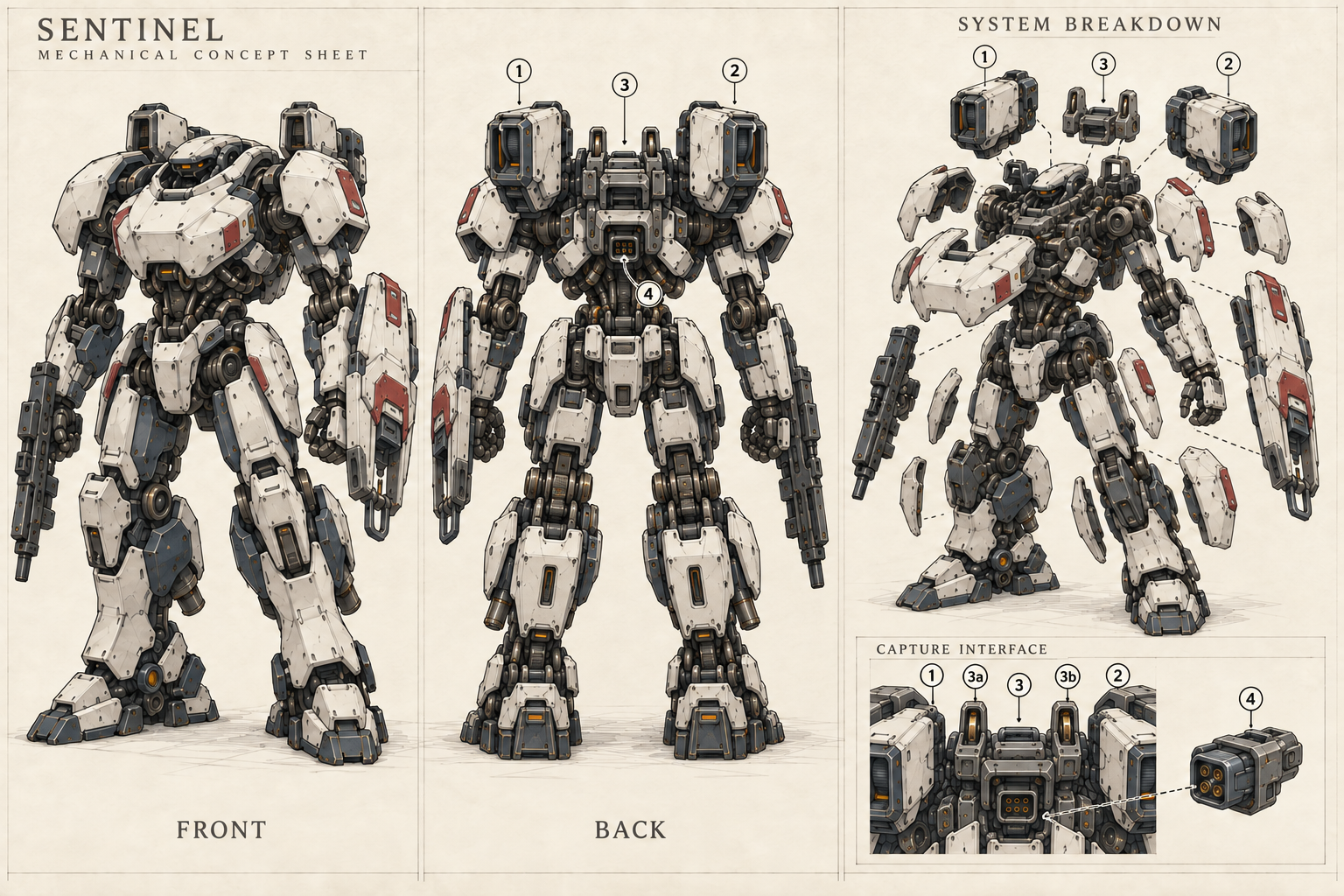
完整生成提示词 2 轮记录 · 原文
AI 图像创作记录 · 保留实际输入原文与修订顺序。
参考图:探索、战斗与采集机体
参考图用于建立新图的设计关系;其自身的生成与修订记录可从对应图片查看。
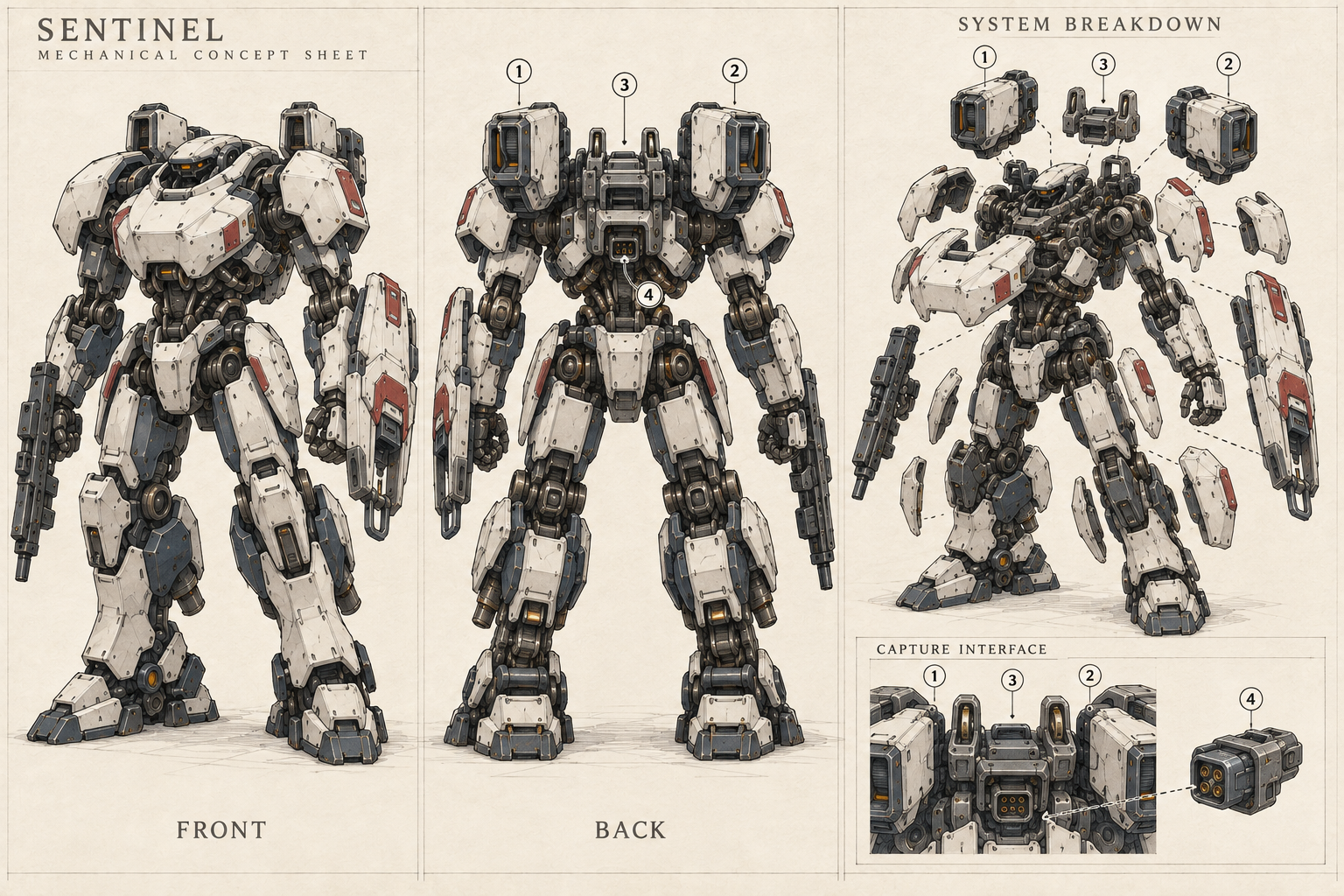
Use case: precise-object-edit. Derive a HAND-DRAWN mechanical concept sheet of the SENTINEL humanoid ONLY from the CENTER machine in input image 1. The reference contains three roles: do NOT redesign the explorer or harvester here. Preserve Sentinel's low flattened hornless head, amber visor recessed in high collar, broad wrapping chest shell and shoulder roots, exposed compact mechanical waist, thick shins, dark knees, short wide feet, warm-white/navy/graphite with sparse brick red. Its LEFT arm carries the same long tool-shield; RIGHT hand the same lowered fictional carbine. Original design, no new V-fin, crown, crystal or decorative wings.
Purpose: resolve the back-equipment ambiguity and explain parts, not a second armor variant.
1536x1024 ivory drawing paper, crisp ink/pencil with muted marker shading. Three main panels:
LEFT: clear full-body FRONT view of the exact same Sentinel, neutral stance, consistent armor shapes.
CENTER: full-body BACK view of the same Sentinel, showing exactly TWO main compact maneuvering pods mounted symmetrically high left and right. Between them is a clearly visible CENTRAL capture saddle, lower than the pod tops, with two mechanical locking lugs and an unobstructed approach path from behind. A protected service connector sits below the saddle. Do not fill that space with a third giant thruster or spine backpack.
RIGHT: exploded three-quarter arrangement of the SAME machine with armored torso shells and shoulder/shin plates displaced only a little from an unarmored mechanical skeleton, the TWO back pods displaced to the sides, central saddle and shield/carbine as separate attached-system parts, dotted guides back to mounting locations. Do not add extra arms or legs, duplicate head or turn the skeleton into a human.
Small lower-right inset: closer saddle/paired locks and disconnected service plug, showing plug attaches only after mechanical capture. Number ONLY four back elements consistently across back and exploded drawings: 1 left pod, 2 right pod, 3 central saddle, 4 service plug. Labels only FRONT / BACK / SYSTEM BREAKDOWN / CAPTURE INTERFACE. No fake dimension text. Keep upper armor silhouette coherent across all three panels; left and right are the machine's own sides. This is a concept assembly, not validated engineering, rigging or weapon construction.
原调用编辑当时的同名图;执行前已将该输入另存为此处的-v1版本,避免引用返修后的结果作为自身输入。
Use case: precise-object-edit. Edit this original SENTINEL mechanical concept sheet to fix two specific review findings. Preserve the whole FRONT figure, colors, silhouette, left-arm shield/right-hand carbine, backpack identity and paper/ink style. 1) In the center BACK view, preserve the upper back with two rectangular propulsion pods, middle docking saddle and service socket. REDRAW THE LOWER HALF AS A TRUE REAR VIEW: rear pelvis plates, back-of-knee actuators, calf rear panels with maintenance slots, ankle back/heel housings facing the viewer. The wide feet point AWAY from the viewer; show heel faces, not the front toe segments. No front groin armor or front shin plates in BACK. Shield stays on machine left (image left in back view) and carbine stays on machine right (image right in back view); do not mirror entire figure. 2) In bottom-right CAPTURE INTERFACE detail, numbers above the two central upright saddle lugs currently incorrectly reuse 1 and 2. Rename these lug callouts '3a' and '3b'. Keep 3 the central docking saddle and 4 the service connector; main back and exploded labels 1 and 2 continue to identify propulsion pods. These are localized corrections; preserve other content and readable compact labels.
完整保留该手稿首次绘制到此版本的提示词原文。历史指令可能包含后来修改或图面尚未达成的要求,不代替概念评审。
这张图的永久记录 ↗巡隼与砺石:作业结构拆解
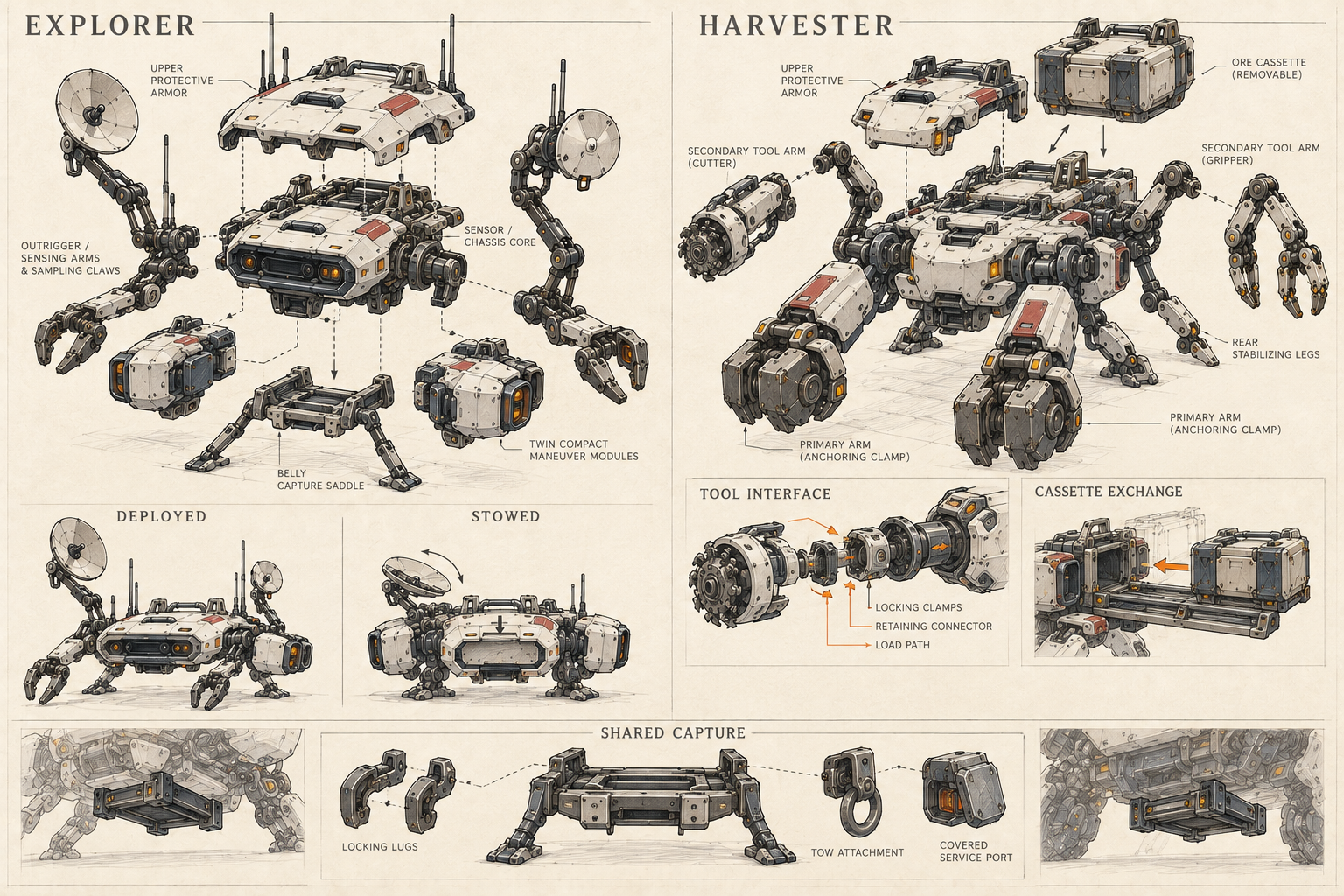
完整生成提示词 1 轮记录 · 原文
AI 图像创作记录 · 保留实际输入原文与修订顺序。
参考图:探索、战斗与采集机体
参考图用于建立新图的设计关系;其自身的生成与修订记录可从对应图片查看。
Use case: precise-object-edit. Derive an ORIGINAL HAND-DRAWN mechanical assembly study from the LEFT EXPLORER and RIGHT HARVESTER in input image 1, preserving their identity. Do not include the humanoid center machine. 1536x1024 ivory drafting paper, pencil/ink and quiet colored marker, warm-white armor, slate blue-gray structure, graphite joints, brick-red identity patches, amber tool warnings. Make two generous columns.
LEFT EXPLORER: show its compact horizontal optical-black sensor face, two articulated sensing outriggers, two sampling claws and short docking skids in a large three-quarter EXPLODED VIEW. Separate only four logical groups by modest distances and dashed assembly lines: upper protective armor, central sensor/chassis core, outrigger/claw mechanisms, twin compact maneuver modules and belly capture saddle. Underneath show the SAME machine in deployed and folded service states. The black sensor-face band must remain IDENTIFIABLE in both; if partly protected during folding, show the actual protective shutter and a simple motion arrow, not an unexplained new face. Arms fold toward the same chassis; no missing or extra appendages.
RIGHT HARVESTER: show the SAME low heavy work core, EXACTLY FOUR main working arms (two thick anchoring clamp arms, two secondary tool arms with cutter and gripper), small rear stabilizing legs, removable rear ore cassette. Explode the upper armor and ore cassette upward and tool tips outward, keep all arm roots attached to the central structural chassis. Show one detailed detachable tool-head mount with paired clamps, retained connector and a load path, plus a small cassette exchange sketch showing one empty dock and the SAME cassette moving along guide rails. Do not double the number of arms or make the ore bin a separate spaceship.
Across bottom center: a shared original rectangular capture saddle, paired locking lugs, tow attachment and covered service port, repeated on both machines in matching relative belly locations. Keep assembly lines clean, no dimension claims, no exact manufacturing specs, no tiny paragraphs. Labels only EXPLORER / HARVESTER / DEPLOYED / STOWED / TOOL INTERFACE / SHARED CAPTURE. Show real mechanical relationships at concept level, not decorative floating parts.
完整保留该手稿首次绘制到此版本的提示词原文。历史指令可能包含后来修改或图面尚未达成的要求,不代替概念评审。
这张图的永久记录 ↗归航号母版:形体与双港口 · 返修前初版
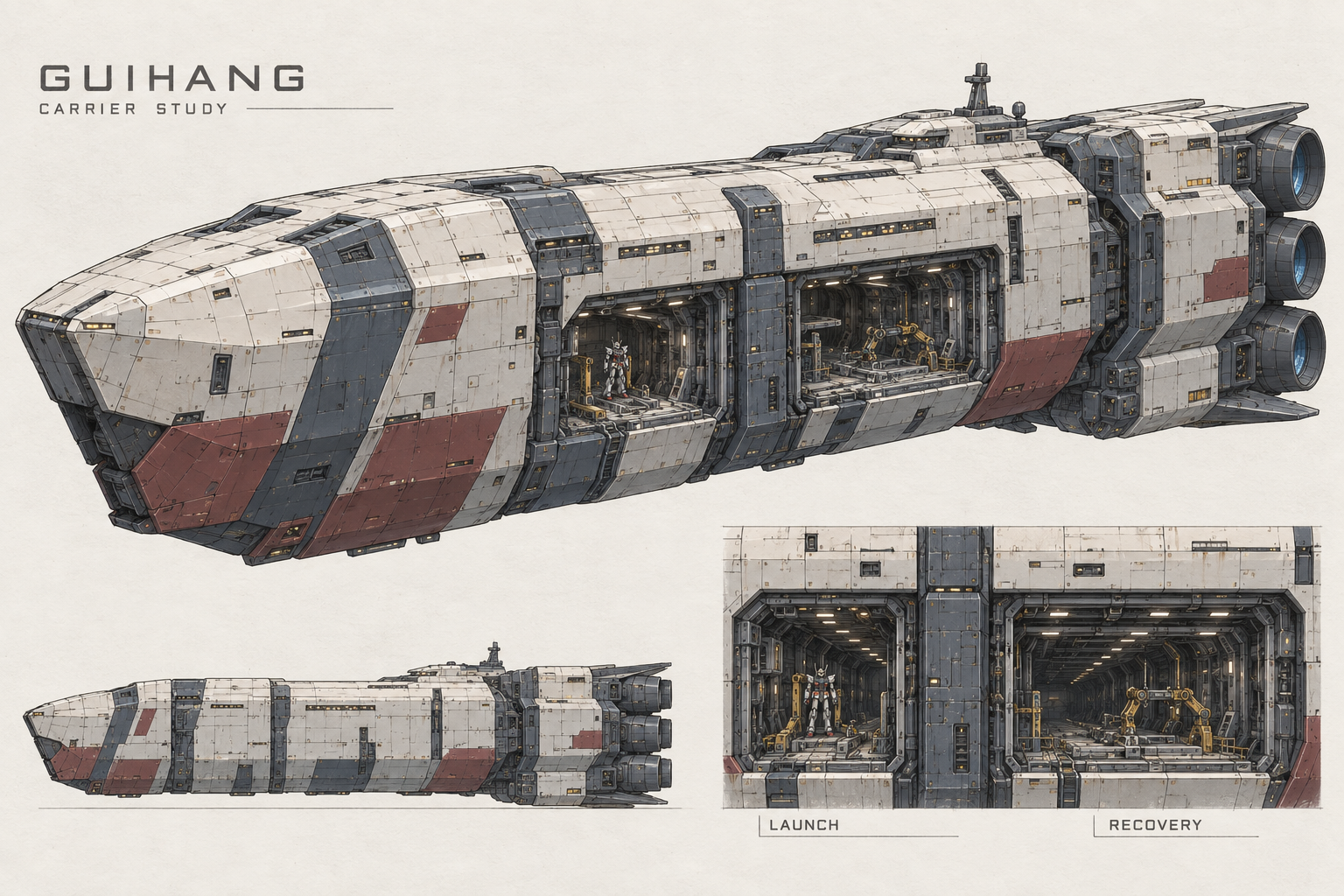
完整生成提示词 1 轮记录 · 原文
AI 图像创作记录 · 保留实际输入原文与修订顺序。
参考图:归航号工业舰船方向初稿
以早期工业舰方向图为编辑输入,转绘为母版手稿;这一步是本手稿的首次生成。
Use case: style-transfer.
Asset type: MASTER HAND-DRAWN CONCEPT SHEET for one original human space-ark carrier GUIHANG. Image 1 is the existing rough design to revise, not a finished ship.
User direction: grounded Mobile Suit Gundam-style naval mechanical design, restrained and handsome, no fantasy monument. FIRST CONCEPT SKETCHES, not Blender renders or final manufacturing drawings.
Revise these specific design weaknesses in the reference:
1. Keep its heavy enclosed long body, short faceted bow, warm-white / slate-blue / graphite / sparse brick-red palette. Replace the monotonous cargo-box profile with THREE clear connected masses: thick protected forward shoulder, slightly recessed midship service waist, broad aft engineering shoulders. These are substantial hull transitions, not wings or added spikes.
2. Make the command bridge a LOW compact semi-recessed armored island in the aft third. Remove the tall forest of naval antenna masts and the giant row of bridge windows. The ship is kilometer-class; fine grouped inhabited window lights must be tiny. Keep one short sensor mast.
3. On the visible PORT side of the midship service waist, clearly show TWO distinct rectangular recessed mouths side by side along the hull length, separated by a thick structural pier. The FORWARD mouth is LAUNCH; the AFT mouth is RECOVERY, a little wider. Actual dark tunnel depth, outer doors, inner framing and guides visible in BOTH mouths. These are side-facing, safely ahead of the stern thrusters. A tiny original humanoid mobile-frame in the launch cradle and a tiny four-arm industrial frame near the recovery mouth identify the carrier's role. No generic shuttle as the only payload.
4. The stern has SIX main engine apertures TOTAL, arranged as TWO columns of THREE, clearly built into sturdy structural modules. Fore-aft direction obvious. From the hero view only the near bank and part of the far bank need be visible. Small attitude thrusters and short cooling vanes; not giant fins.
5. Preserve a broad quiet sealed forebody for sleeping community, a thin grouped habitation band above the waist, dense service details only around the two ports, and separately colored aft machinery. A few replaced panels and dark sealed sectors imply a long life; no luxurious terraces or exposed parks.
Layout 1536x1024 landscape, tasteful HAND-DRAWN DESIGN SKETCH presentation on off-white paper. Top 70 percent: one complete revised mother ship in front-port three-quarter view, enough side visible to read both ports, generous margins. Bottom left 25 percent: small strict SIDE silhouette sketch of the SAME ship, showing the low bridge and three mass transitions. Bottom right 25 percent: enlarged mechanical detail of the SAME paired side ports with central divider, 20-meter-class mecha dwarfed by the doorway, thick opening rim and inner rail/capture frame. Labels ONLY "GUIHANG / CARRIER STUDY", "LAUNCH", "RECOVERY" in small restrained drafting typography. No fake handwritten paragraphs, no dimensions, no second ship alternative.
Style: professional original anime-mecha designer's exploratory pen/pencil and marker sheet, clean purposeful contour lines with subtle construction lines, restrained color blocking, crisp shaded angular surfaces, legible dark mechanical recesses. Beauty through proportions and controlled detail. NOT a photograph, CGI product render, stone building, rounded seed, crown, scythe, luxury liner or toy. Do not copy Archangel's split prow, any Gundam logo or any existing franchise ship. No gun batteries, space background, planets or bright engine bloom. This is a concept mother sheet, not a validated technical projection.
该图是保留的初版;本记录只列产生这张初版的指令,后续编辑链见对应当前手稿。
这张图的永久记录 ↗同舰六视图研究 · 返修前初版
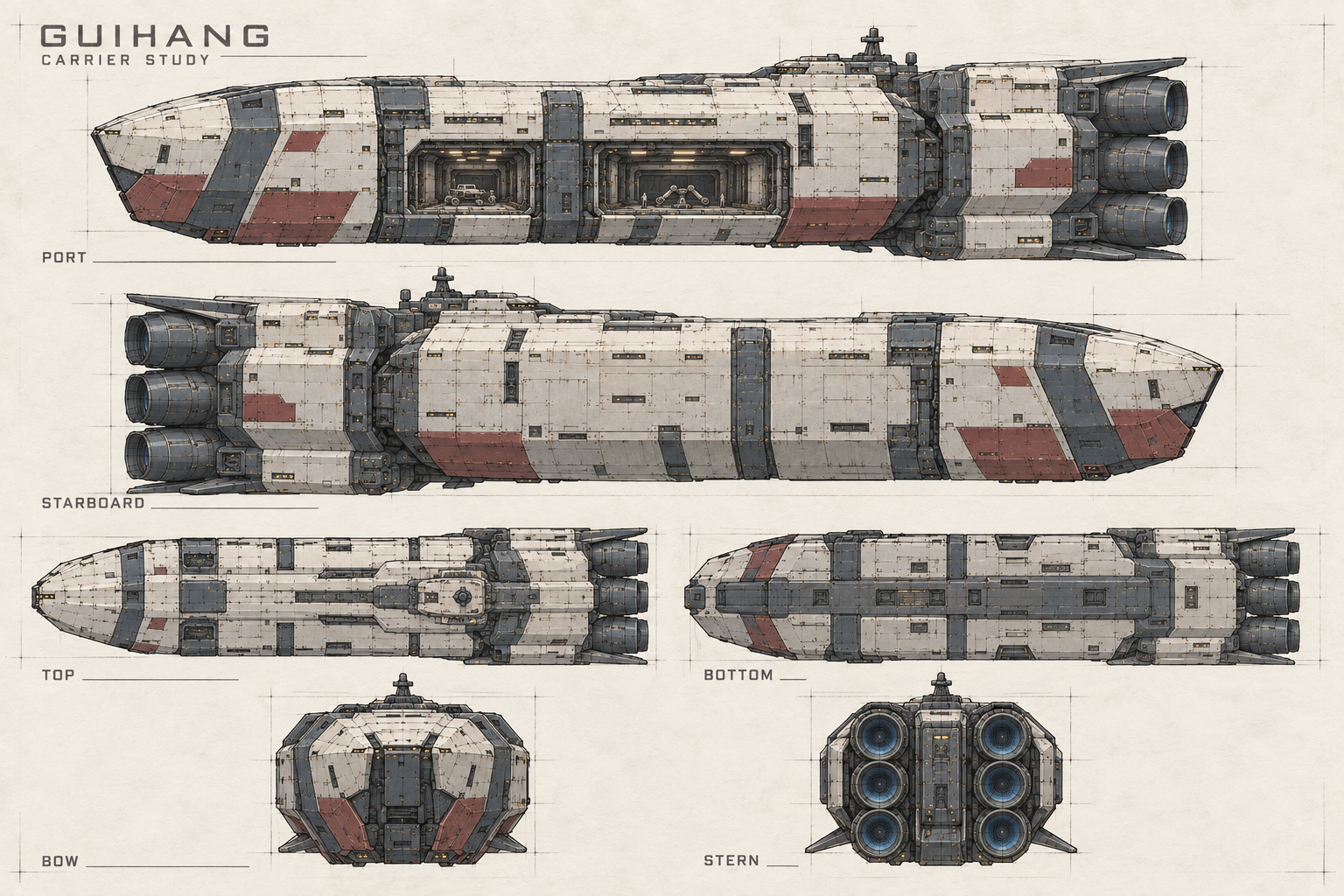
完整生成提示词 1 轮记录 · 原文
AI 图像创作记录 · 保留实际输入原文与修订顺序。
参考图:归航号母版:形体与双港口
参考图用于建立新图的设计关系;其自身的生成与修订记录可从对应图片查看。
Use case: stylized-concept. Create an original HAND-DRAWN industrial mecha concept-development sheet on ivory drafting paper, 1536x1024 landscape. Match input image 1, the GUIHANG mother ship master, as the authoritative exterior visual identity. Warm-white armor, slate blue-gray structure, graphite recesses, sparse brick-red identification, amber work lights. Crisp pencil/ink contour, light construction lines, controlled marker shadows. No photoreal CGI, no fantasy monument, no generic new ship or copied franchise, no fake dimension numbers, no unreadable handwritten paragraphs. These are concept views, not validated engineering projections. Preserve low bridge aft of center, short faceted bow, thick enclosed body, TWO port-side midship mouths separated by one thick pier (forward LAUNCH, aft RECOVERY), six aft engine apertures total in two columns of three, only short fins. Small figures in the reference are schematic, not exact scale evidence.
Asset: coherent six-view concept sheet of this SAME ship, not six alternatives. Layout top two rows each with two long horizontal ship views; bottom row with two end views and generous blank margins. Labels only PORT, STARBOARD, TOP, BOTTOM, BOW, STERN.
PORT: bow left, stern right, BOTH rectangular side service mouths visibly open at the midship waist, bridge in same aft position and three visible near-bank nozzles.
STARBOARD: mirror longitudinal orientation with bow right, stern left; opposite side is plated service access with CLOSED rectangular maintenance panels, no invented open garden or symmetric active hangar.
TOP: bow left and stern right, one central longitudinal spine, paired shoulder masses, compact low bridge, near-side hangar recess corresponding to PORT. BOTTOM: bow left and stern right, reinforced keel and maintenance hatches; no bridge and no duplicated dorsal details.
BOW: short faceted nose facing directly toward viewer, broad shoulder silhouette behind it and tiny centered bridge silhouette above; NO engine holes at the nose.
STERN: directly behind, exactly SIX main nozzles as two vertical columns of THREE circles; structure between columns, tiny bridge above. Do not turn them into four or eight.
All views in restrained mostly orthographic drawing language, no extreme perspective, line weight separates primary silhouette from panel detail. Keep the same bow slope, hull beam, bridge location, port longitudinal position and engine count across ALL views. Fill the page elegantly without overlap. Do not add decorative inset shapes or extra views.
该图是保留的初版;本记录只列产生这张初版的指令,后续编辑链见对应当前手稿。
这张图的永久记录 ↗总体拆解与舱段剖面 · 返修前初版
完整生成提示词 1 轮记录 · 原文
AI 图像创作记录 · 保留实际输入原文与修订顺序。
参考图:归航号母版:形体与双港口
参考图用于建立新图的设计关系;其自身的生成与修订记录可从对应图片查看。
Use case: stylized-concept. Create an original HAND-DRAWN industrial mecha concept-development sheet on ivory drafting paper, 1536x1024 landscape. Match input image 1, the GUIHANG mother ship master, as the authoritative exterior visual identity. Warm-white armor, slate blue-gray structure, graphite recesses, sparse brick-red identification, amber work lights. Crisp pencil/ink contour, light construction lines, controlled marker shadows. No photoreal CGI, no fantasy monument, no generic new ship or copied franchise, no fake dimension numbers, no unreadable handwritten paragraphs. These are concept views, not validated engineering projections. Preserve low bridge aft of center, short faceted bow, thick enclosed body, TWO port-side midship mouths separated by one thick pier (forward LAUNCH, aft RECOVERY), six aft engine apertures total in two columns of three, only short fins. Small figures in the reference are schematic, not exact scale evidence.
Asset: clear hull decomposition and internal zoning CONCEPT study for the SAME mother ship.
Upper 60 percent: three-quarter EXPLODED ASSEMBLY drawing of the vessel with its coherent graphite structural backbone continuous. Lift only the major warm-white external armor sections slightly away with dotted guide lines: forward protection/nose cap, preserved-community compartment shells, central dorsal cover, port hangar shoulder cover, aft power cover. Keep both launch/recovery mouths together as a single side assembly. Aft complete engine assembly remains SIX nozzles, two columns of three. Explosion is modest and readable, not a cloud of random parts. Inner functional modules are large architectural volumes, not fully engineered reactors.
Lower 40 percent: same ship in PORT-side longitudinal CUTAWAY, bow left stern right. Clearly separate seven zones in this order and with tiny English labels only: SHIELD at bow, PRESERVATION with isolated sleeping/seed compartments forward, HABITAT inside protected midbody, HANGAR on port side of that region, INDUSTRY aft of habitats, POWER well aft, DRIVE at stern.
HABITAT is an ENCLOSED rotating-drum candidate INSIDE the hull, longitudinal axis, located inward and toward starboard from the port hangar. Show its curved residential decks as an internal module, not an enormous ring sticking out of the exterior or a floating garden. Central service spine is nonrotating. Hangar side module occupies a DISTINCT volume, not drawn through the residential drum. Show a simple separation between life/preservation systems and aft power volume. Front preserved-community blocks have redundancy, not one fragile glowing crystal.
Keep the open twin side bays in the same place as the exterior and the bridge small. Use lightly differentiated muted tints for zones and solid simple structural interfaces. No energy magic, no giant fuel flames, no arbitrary rooms whose scale pretends to be validated. Show how the parts relate; no numerical measurements.
该图是保留的初版;本记录只列产生这张初版的指令,后续编辑链见对应当前手稿。
这张图的永久记录 ↗公共生活舱与旋转段 · 返修前初版
完整生成提示词 1 轮记录 · 原文
AI 图像创作记录 · 保留实际输入原文与修订顺序。
参考图:归航号母版:形体与双港口
参考图用于建立新图的设计关系;其自身的生成与修订记录可从对应图片查看。
Use case: stylized-concept. Create an original professional HAND-DRAWN CONCEPT sheet, 1536x1024 landscape, ivory paper, crisp pencil/ink, light construction lines, restrained colored markers. Same design family as the GUIHANG mother ship in input image 1: warm-white panels, blue-gray thick structure, graphite mechanical recesses, sparse brick-red identity blocks, local amber work lights, serviceable modular parts. No photoreal CGI, no generic luxury spacecraft, no random glowing holograms, no dimension claims, no dense fake text. This is concept development before Blender, not an engineering drawing.
Asset: a communal room inside the ark's enclosed ROTATING HABITAT candidate, intimate human life, not a luxury liner. Upper 65 percent: one human-eye-level interior perspective. A long narrow modular room with subtle curved deck and repeating structural ribs, eight seats around one shared table, seven simple meal settings, a food-service niche, storage wall and an ordinary sealed door leading to an unawakened residential sector. No huge exterior window: room is deep inside protected hull. Small porthole into another pressurized circulation corridor only. Lit active half uses warm white panels, worn composite tabletop, fabric acoustic pads and a few repaired cup straps; closed sector beyond the far door stays cool and quiet. Show two or three ordinary crew in maintenance clothes sharing work/food, no royalty, no magic technology. Trays and cups have modest anti-spill clips. A folded garment and a repaired textile sleeve make it feel like a lived-in home. Thin brick-red door identification panel, physically attached rail lights.
Bottom left: plain PLAN, eight-seat table in center, service niche and lockers along one wall, entry on one end and sealed sector door opposite. Plan must match main perspective rather than invent another room.
Bottom center: tiny section diagram showing the room on the INNER curved deck of an ENCLOSED rotating drum inside a nonrotating hull. Its floor's outward radial direction is clear. A central nonrotating service spine and a small controlled transfer vestibule are distinct; do not connect ordinary doors directly between incompatible rotating structures. This is a schematic conceptual relationship, not solved bearings.
Bottom right: exploded TABLE assembly with anchored serviceable base, replaceable slab, removable tray/cup clips, underside service-light rail, dotted assembly guides. No houseplants, decorative trees, chandeliers, glass city dome or balconies.
Labels only COMMON ROOM / PLAN / HABITAT SECTION / TABLE MODULE. Mood: a few people slowly bringing a vast ship back to life.
该图是保留的初版;本记录只列产生这张初版的指令,后续编辑链见对应当前手稿。
这张图的永久记录 ↗守望:结构与维护接口 · 返修前初版
完整生成提示词 1 轮记录 · 原文
AI 图像创作记录 · 保留实际输入原文与修订顺序。
参考图:探索、战斗与采集机体
参考图用于建立新图的设计关系;其自身的生成与修订记录可从对应图片查看。
Use case: precise-object-edit. Derive a HAND-DRAWN mechanical concept sheet of the SENTINEL humanoid ONLY from the CENTER machine in input image 1. The reference contains three roles: do NOT redesign the explorer or harvester here. Preserve Sentinel's low flattened hornless head, amber visor recessed in high collar, broad wrapping chest shell and shoulder roots, exposed compact mechanical waist, thick shins, dark knees, short wide feet, warm-white/navy/graphite with sparse brick red. Its LEFT arm carries the same long tool-shield; RIGHT hand the same lowered fictional carbine. Original design, no new V-fin, crown, crystal or decorative wings.
Purpose: resolve the back-equipment ambiguity and explain parts, not a second armor variant.
1536x1024 ivory drawing paper, crisp ink/pencil with muted marker shading. Three main panels:
LEFT: clear full-body FRONT view of the exact same Sentinel, neutral stance, consistent armor shapes.
CENTER: full-body BACK view of the same Sentinel, showing exactly TWO main compact maneuvering pods mounted symmetrically high left and right. Between them is a clearly visible CENTRAL capture saddle, lower than the pod tops, with two mechanical locking lugs and an unobstructed approach path from behind. A protected service connector sits below the saddle. Do not fill that space with a third giant thruster or spine backpack.
RIGHT: exploded three-quarter arrangement of the SAME machine with armored torso shells and shoulder/shin plates displaced only a little from an unarmored mechanical skeleton, the TWO back pods displaced to the sides, central saddle and shield/carbine as separate attached-system parts, dotted guides back to mounting locations. Do not add extra arms or legs, duplicate head or turn the skeleton into a human.
Small lower-right inset: closer saddle/paired locks and disconnected service plug, showing plug attaches only after mechanical capture. Number ONLY four back elements consistently across back and exploded drawings: 1 left pod, 2 right pod, 3 central saddle, 4 service plug. Labels only FRONT / BACK / SYSTEM BREAKDOWN / CAPTURE INTERFACE. No fake dimension text. Keep upper armor silhouette coherent across all three panels; left and right are the machine's own sides. This is a concept assembly, not validated engineering, rigging or weapon construction.
该图是保留的初版;本记录只列产生这张初版的指令,后续编辑链见对应当前手稿。
这张图的永久记录 ↗门机与横向转运 · 返修前初版
完整生成提示词 1 轮记录 · 原文
AI 图像创作记录 · 保留实际输入原文与修订顺序。
参考图:港口与机库 · 归航号母版:形体与双港口 · 探索、战斗与采集机体
参考图用于建立新图的设计关系;其自身的生成与修订记录可从对应图片查看。
Use case: stylized-concept. Draw a focused HAND-DRAWN PORT MECHANISM and TRANSFER concept sheet for the SAME GUIHANG twin side hangars in images 1 and 2, machines from image 3. Ivory paper, pencil/ink construction lines, warm-white/blue-gray/graphite and sparse brick-red, quiet marker shading. Landscape 1536x1024. This is explanatory concept design, not actual engineering certification.
Top half: THREE matching side-section panels of ONE MACHINE TRANSIT DOOR: CLOSED / LIFTING / OPEN. Commit to a clear ORIGINAL design refinement: one reinforced door leaf lifts VERTICALLY into a tall protected pocket directly ABOVE the same opening, guided by rails on both jambs. Show the complete pocket height and upper closed end, actual leaf remains INSIDE hull structure in the OPEN panel, never floating above hull. Door down blocks opening in CLOSED, halfway up in LIFTING, completely clear of the same vehicle transit opening in OPEN. One clean upward arrow for motion. Keep leaf thickness, opening dimensions and hardware consistent across the three panels. An amber interlock and fixed inner capture rail are present; leaf motion must not pass through the captured machine.
Bottom left 55 percent: legible TOP-DOWN floor/rail diagram of the SAME two independent side-facing lanes. Exterior space to LEFT; launch upper lane arrow outward LEFT; recovery lower lane arrow inward RIGHT. Both lanes end at one shared TRANSFER SHUTTLE track running vertically along their inboard ends. A mobile carriage on that cross-track transfers a LOCKED machine cradle between lane and maintenance berth; draw rails and carriage explicitly, not rail segments ending in empty space. Two clear HOLD marks ensure one machine movement at a time through shared transfer, not simultaneous crossing. Add dedicated UNLOAD pocket beside recovery and ISOLATION/REPAIR pocket beyond it, separated from the outgoing lane. Minimal labels LAUNCH / RECOVERY / TRANSFER / HOLD / UNLOAD / ISOLATION.
Bottom right: one perspective mechanical detail of the transfer carriage with a neutral folded machine locked on top, visible clamps, cross-rail wheels/guides and service connector still disconnected until fixation. Tiny suited human tethered nearby provides approximate scale only; no exact sizes.
Keep the two exterior ports and central structural pier consistent with prior sheets. The pressure boundary is the small service boxes, not the entire vacuum working hangar. NO mecha battle, no three exterior doors, no dimensions, no unrelated hull redesign or decorative background.
该图是保留的初版;本记录只列产生这张初版的指令,后续编辑链见对应当前手稿。
这张图的永久记录 ↗不落之冠
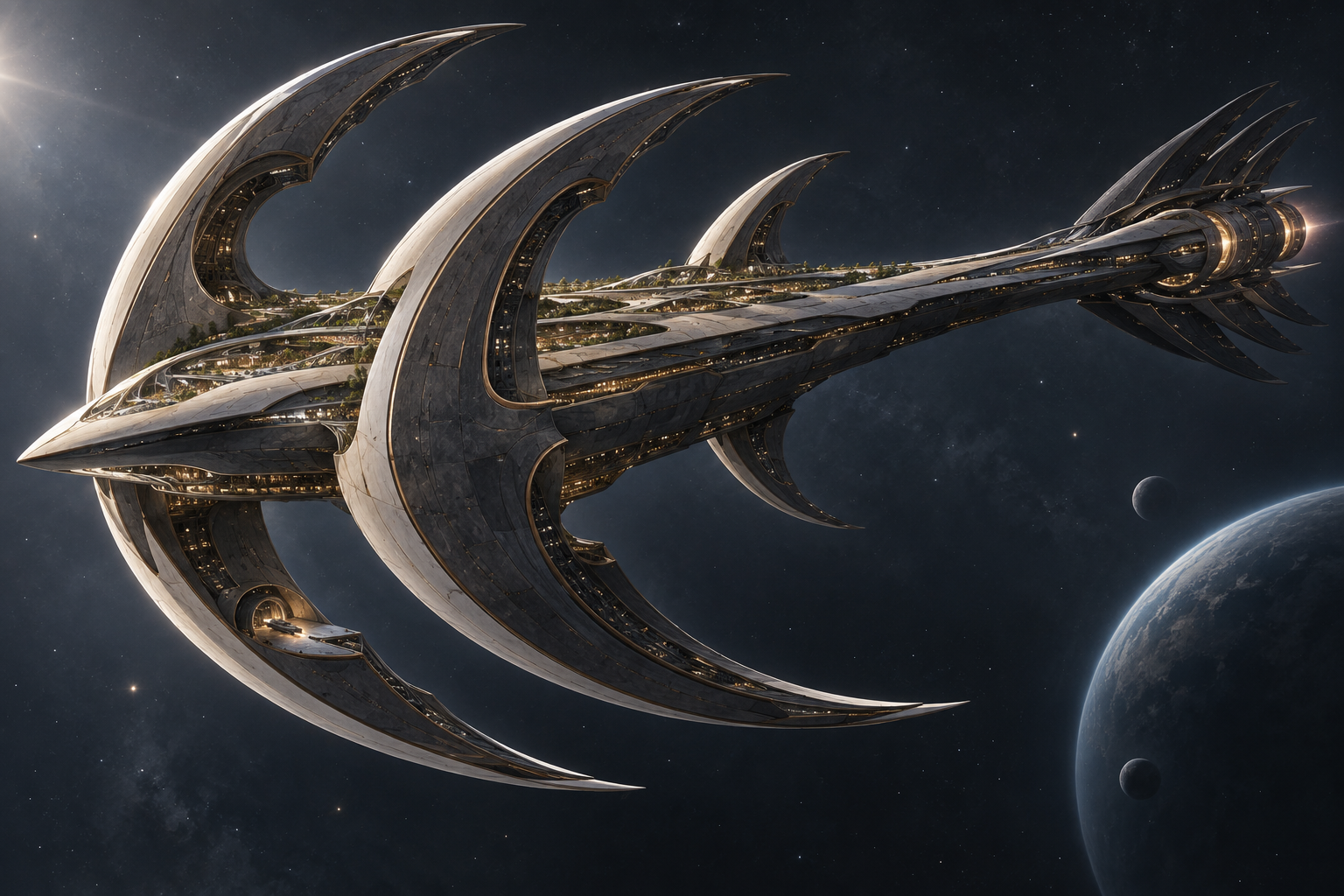
完整生成提示词 1 轮记录 · 原文
AI 图像创作记录 · 保留实际输入原文与修订顺序。
Use case: stylized-concept. Asset type: original hero spaceship visual-development painting for a premium science-fiction civilization/survival game, Stellar Echoes. Create one unforgettable, breathtaking HUMAN MIGRATION ARK, concept A "Crown of Dawn". The vessel must feel like an ancient promise carried into the distant future: majestic, sheltering, audacious and desirable to command.
Primary silhouette: a gigantic OPEN crescent of dark sculpted structural arches embracing a slender luminous inhabited keel. The crescent is steeply tilted across the axial hull, split into three staggered architectural crown blades with large clean negative spaces; they are attached to a long tapering axial tail with unmistakable aft propulsion integrated into its end. It is a travelling city-ship, not a circular space station, portal or fighter. Protective basalt-gray shell planes, sweeping ivory ceramic leading edges, sparse warm bronze edges. Inside the protective arches, tiny layered terraces and ribbon-thin amber habitation lights suggest thousands of sleeping lives. One deliberately placed recessed sheltered harbor with a tiny shuttle for scale. Confident broad surfaces, refined transition lines, 70/20/10 hierarchy of large/medium/tiny details. Cool near-black recesses, sunlit pale edges, restrained amber inner light. Heat-control fins read as elegant dark layered feathers behind the main silhouette, not solar panels pasted everywhere.
Composition: landscape 1536x1024; one complete vessel entirely in frame, 75% frame coverage, front/side three-quarter view with the tail visible. Quiet dark blue-gray deep-space background, very sparse stars and subtle diffuse illumination; clear edge separation. Premium painterly industrial concept art with believable material depth, delicate drafting intelligence, great monumental scale. Beauty must come from proportion, voids and form, not explosions or busy nebulae. No labels, typography, logo, diagrams, UI, weapon racks, giant fighter cockpit, blunt shipping-container grids, gothic ornament or existing franchise ship copies. This is a NEW silhouette exploration, unconstrained by any previous ark image. No simulated blueprint claims.
原始独立生图,没有输入参考图片。此方向已停止深化,保留创作过程与完整指令。
这张图的永久记录 ↗远行碑
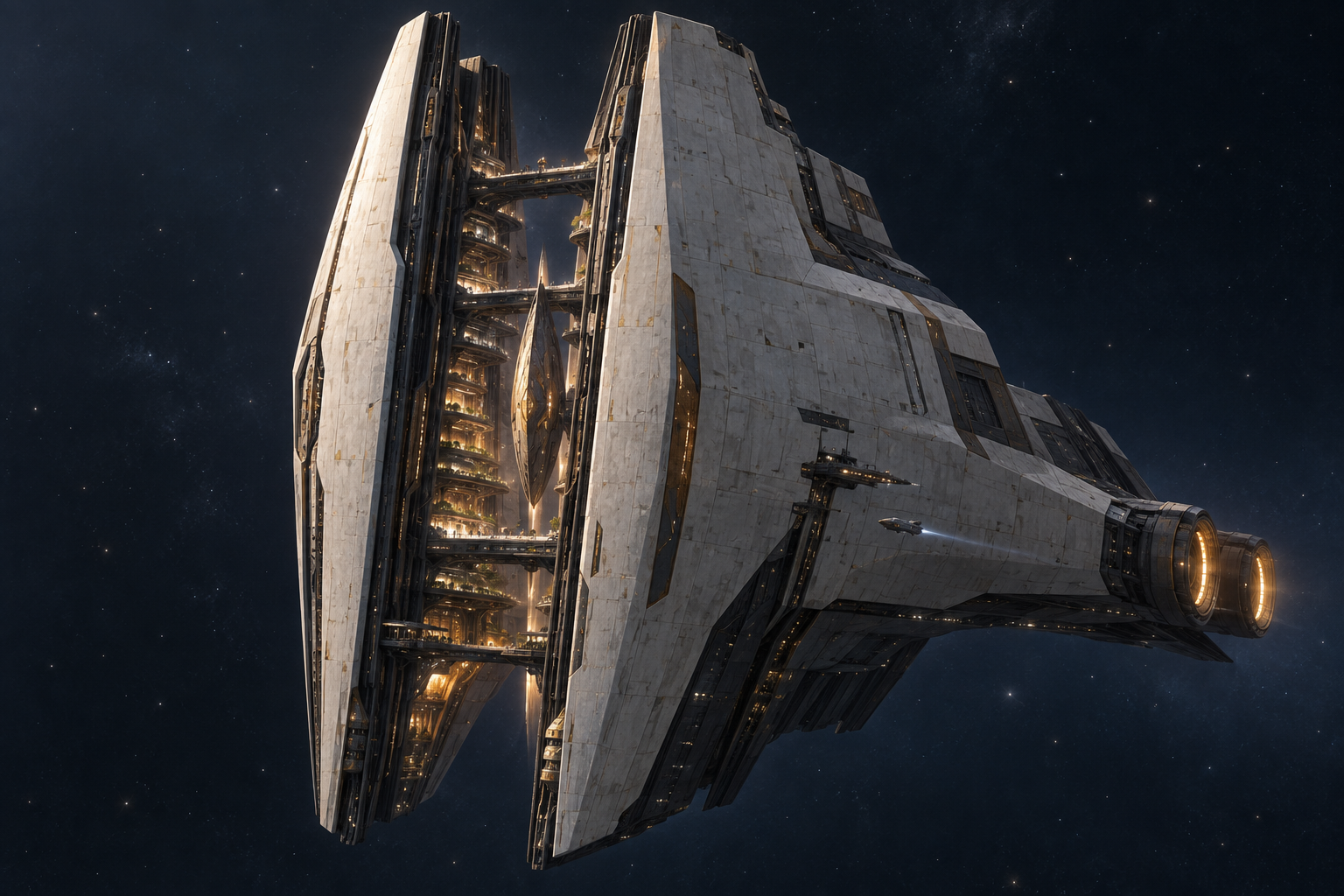
完整生成提示词 1 轮记录 · 原文
AI 图像创作记录 · 保留实际输入原文与修订顺序。
Use case: stylized-concept. Asset type: original hero spaceship visual-development painting for a premium science-fiction civilization/survival game, Stellar Echoes. Create one unforgettable HUMAN MIGRATION ARK, concept B "Pilgrim Monolith": austere, bold, mysterious, something a player would love to approach and eventually call home.
Primary silhouette: a colossal TALL VERTICAL split monolith moving through space, roughly three times taller than its fore-aft depth, like two elegantly tapered opposing blade-like bastions leaning apart around a long central narrow inhabited chasm. The profile has one striking offset shoulder and a short powerful aft tail connecting the towers: deliberately restrained asymmetry, no standard triangular cruiser. Each bastion has a strong broad pale ceramic face over a graphite inner structure. Negative space between the two enormous volumes reveals deeply nested warm city terraces and a suspended central sanctuary keel supported by visibly massive crossbridges. Two small-looking but monumental propulsion apertures are on the aft horizontal tail; minute side-mounted service docks and a single shuttle establish scale and vehicle direction. The ship is a civilization carrier, not a weapon or building floating without engines. Externally minimal, internally intricate. Broad quiet surfaces, select bronze repair inlays, clustered warm habitation light rather than uniform windows, a few sharply folded dark thermal fins at the aft mass. One controlled asymmetry makes it memorable and still engineered.
Composition: landscape 1536x1024; one complete vessel entirely in frame, 75% frame coverage, front/side three-quarter view showing the depth, sheltered chasm and aft tail. Quiet dark blue-gray space background, very sparse stars, no planet stealing attention. Crisp oblique light on large forms, soft warm human-scale interior glow. Premium painterly industrial concept art, dramatic scale, intelligent materials and proportions, no explosions, no nebula spectacle. No labels, typography, logos, UI, diagrams, big fighter cockpit, guns, skulls, stone masonry, religious ornament or franchise ship copies. The form must be wildly distinct from a normal winged cruiser or wheel station. New silhouette exploration; not an engineering blueprint.
原始独立生图,没有输入参考图片。此方向已停止深化,保留创作过程与完整指令。
这张图的永久记录 ↗星种
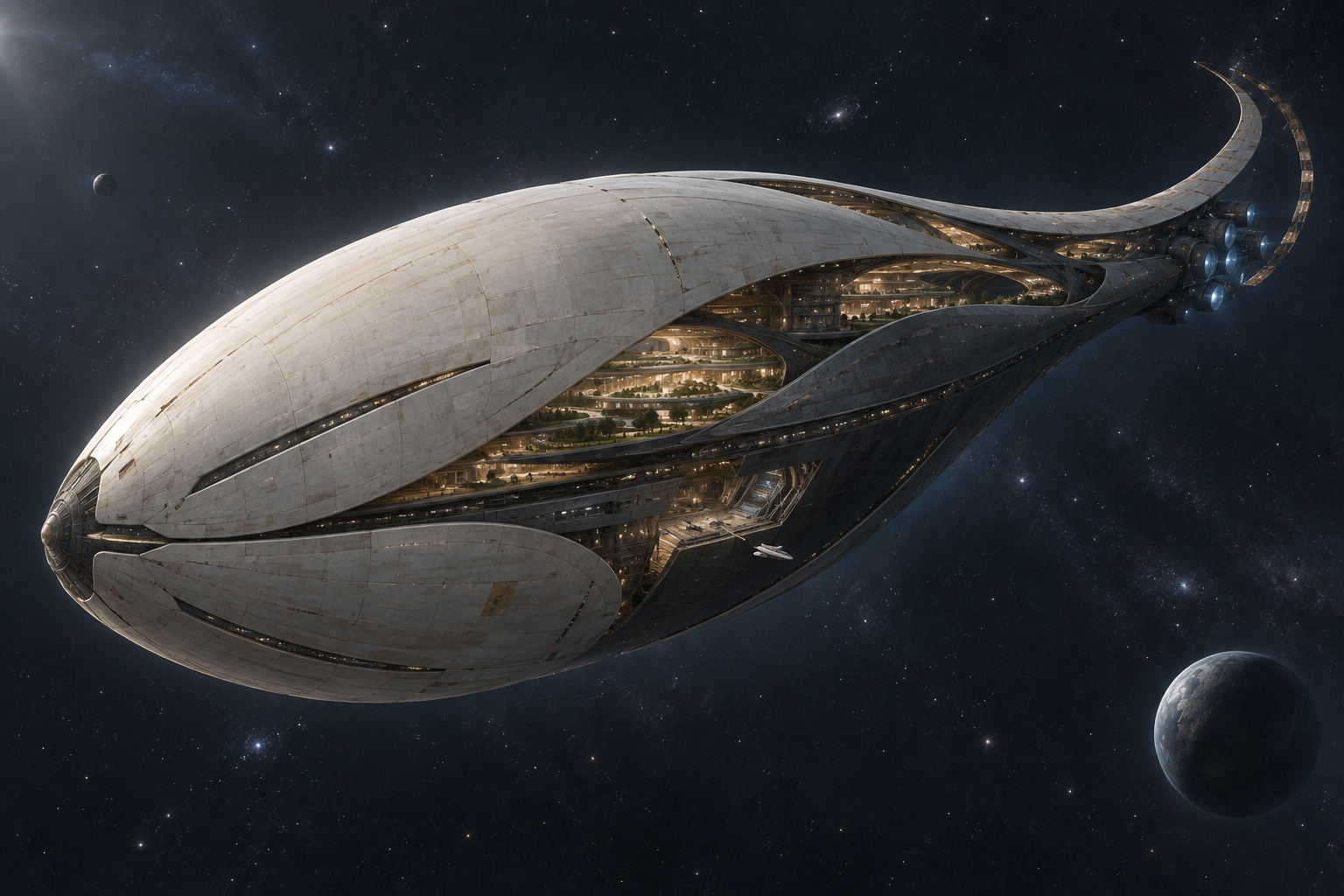
完整生成提示词 1 轮记录 · 原文
AI 图像创作记录 · 保留实际输入原文与修订顺序。
Use case: stylized-concept. Asset type: original hero spaceship visual-development painting for a premium science-fiction civilization/survival game, Stellar Echoes. Create one unforgettable HUMAN MIGRATION ARK, concept C "Stellar Seed": profound, elegant, alive and protective, a civilization sailing through dark space.
Primary silhouette: an elongated tapered SEED enclosed by THREE unequal sweeping protective shell leaves. The main shell is a huge immaculate pearl-ceramic curved vault, a second darker shell sweeps underneath, the third arcs outwards into a graceful narrow stern. Their overlapping open seams form long asymmetric crescent-shaped negative spaces exposing amber-lit internal town terraces, a glimpse of protected cultivation, bridges and the finely layered graphite axial skeleton. These are manufactured, segmented megastructural shells with purposeful connections, not organic flesh, flower petals, literal wings or glass greenhouse domes. One extremely fine offset arc of thermal structures follows the stern and a compact constellation of modest blue-white propulsion apertures marks the trailing end. A sheltered harbor set into the lower seam, with one tiny service shuttle, establishes that this several-kilometre object carries a community. Avoid aggressively pointed destroyer proportions; calm flowing mass with one memorable sweep, restrained pale ceramic, graphite seams and small warm bronze repair accents. Broad clean planes dominate; fine density is concentrated in the openings.
Composition: landscape 1536x1024; one complete ship entirely in frame, 75% frame coverage, front/side three-quarter view with tail visible. Quiet dark blue-gray deep-space background, sparse stars, subtle oblique light and readable silhouette. Premium painterly industrial concept art with sculptural elegance, immense scale and convincing manufactured surfaces. Let the luminous sheltered interior promise a home. Beauty from shape and light, no explosions, huge nebula, fantasy glowing magic core or giant artificial tree. No labels, typography, logos, UI, diagrams, cockpit bubble, weapon batteries or existing franchise ship copies. Completely new silhouette study, not an engineering blueprint.
原始独立生图,没有输入参考图片。此方向已停止深化,保留创作过程与完整指令。
这张图的永久记录 ↗归航号工业舰船方向初稿
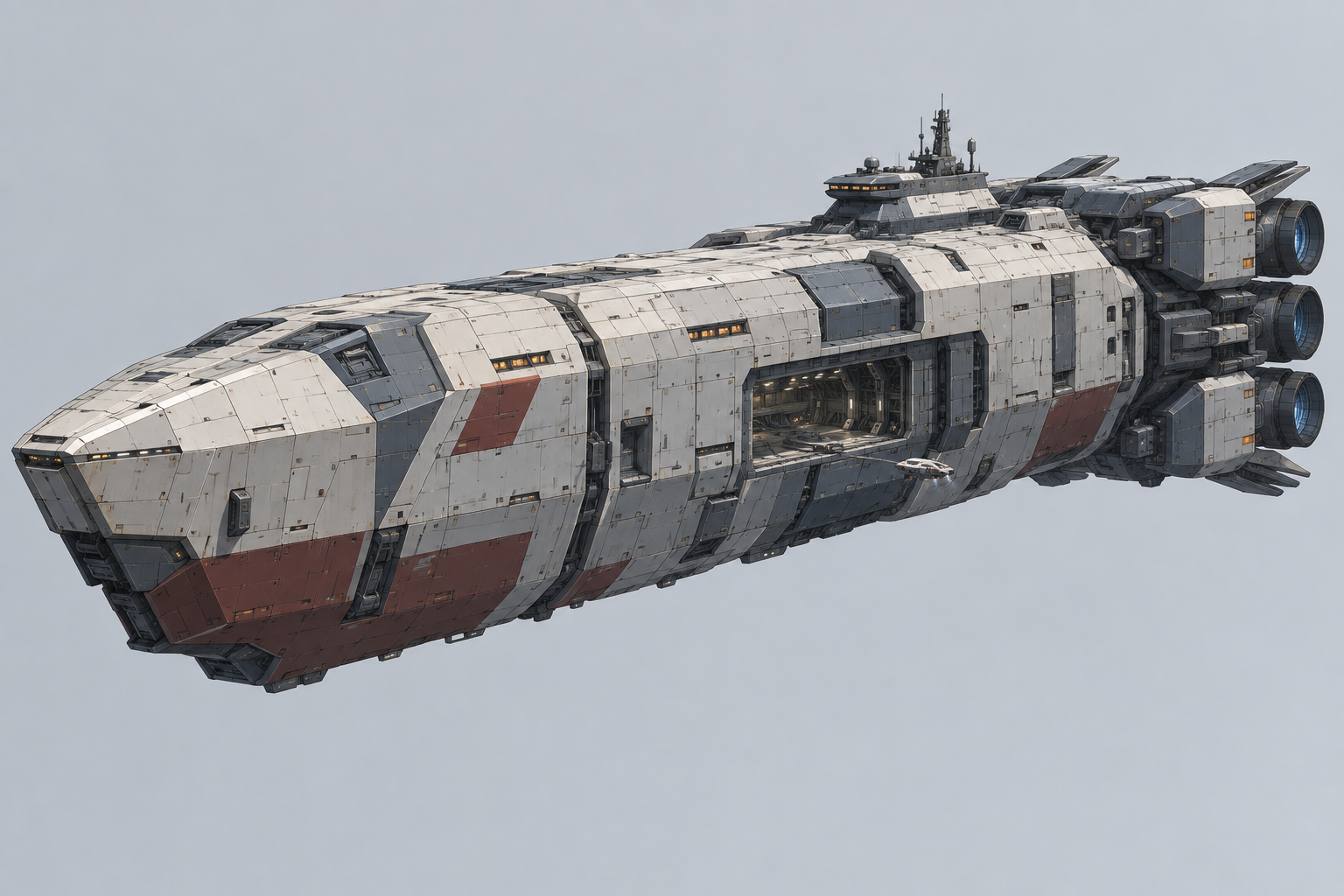
完整生成提示词 1 轮记录 · 原文
AI 图像创作记录 · 保留实际输入原文与修订顺序。
Use case: stylized-concept.
Asset type: a single original spaceship concept illustration for the game Stellar Echoes, human migration ark GUIHANG.
Primary request: redesign the ark using the disciplined naval/mechanical visual language of Mobile Suit Gundam spacecraft. The prior concepts were rejected as extravagant fantasy monuments. This image must immediately read as a convincing, handsome, powerful HUMAN SPACE CARRIER: unmistakable bow, continuous long main hull, small raised bridge, recessed hangar, heavy stern engine blocks. Original ship design, not a replica or a collage of any existing Gundam vessel.
Shape: one long, deep, substantial centerline hull, approximately five times as long as its width. A short faceted chisel-shaped prow, NOT a long needle. The large inhabited midship hull carries two stout armored shoulder volumes smoothly stepped into the main hull, not detached prongs. A compact two-tier command island rises above the aft third with short sensor masts; it must be very small relative to the ship. Thick side plating breaks into a handful of purposeful large sections with deep mechanical recesses between them. Visible near-side recessed rectangular shuttle hangar at midships, deep internal ribbing, doors, service gantry, one tiny shuttle entering. Strong connected stern structure contains four deep large engine nozzles with only soft blue idle illumination. Small attitude thrusters and short robust cooling vanes integrated close to the stern; no giant wings. The entire load path from armored bow to inhabited midbody to engines is visually coherent.
Civilization-ark identity: the ship has enormous enclosed deck depth, repeated sealed habitation sectors inside its thick midbody, a few tiny grouped warm window bands and one modest illuminated working port. Most sections are dark and sealed. Service bays, cargo hatches and small replacement armor patches convey long use. Interiors are protected; no exposed parks, forests, continuous luxury terraces, or decorative floating cores. A tiny 20-meter service craft beside the near-side hangar establishes the kilometer-class scale. Prioritize a memorable silhouette, not endless greebles or labels.
Art direction: professional high-end Japanese anime mecha spacecraft concept art with crisp intentional structural drawing and beautifully shaded hard-surface volumes. Hull planes in warm off-white and muted blue-gray; dark graphite mechanical depths; restrained brick-red identification blocks on the lower hull and shoulders, very small amber hazard marks. Naval industrial confidence, restrained asymmetric maintenance details on an otherwise balanced ship. Large clean planes dominate, medium block transitions support them, minute detail only at service interfaces. Subtle scuffs and repairs, not rusty wreckage. Emotion: formidable, dependable, a ship you want to command and return home to.
Composition: landscape 1536x1024, one complete ship only, elegant front-port three-quarter view with enough broadside and stern visible to read hangar and engines. Whole ship fits with generous margins, fills about 80 percent width. Neutral pale cool-gray presentation background and clear studio-style directional lighting; no planets, stars, explosions, lens flares, dramatic nebulae or cinematic background to disguise the design. One tiny service craft for scale, otherwise no other vessels. No text, logos, UI, borders, weapon batteries, mecha characters, halos, curved scythe blades, towers resembling buildings, giant rings, petals, seed shape, ornamental gold trim or marble. This is concept art, not a claim of engineering validation.
原始独立生图,没有输入参考图片。后来的母版转绘引用此图,但当前母舰已增加双港口并调整局部关系。
这张图的永久记录 ↗